

 10 min read
There's a statistic that stops most people in their tracks when I share it. Ninety-five percent of Dutch businesses are currently experimenting with AI. The Netherlands is leading Europe in adoption. And yet only five percent are seeing true business value from it.
Five percent.
That gap tells you everything you need to know about where the real challenge lies right now. And it's probably not where you think it is.
AI doesn't transform your business automatically. What it does is amplify whatever's already there. If your business is fast, aligned, and operating with clarity, AI accelerates growth. If your business is siloed, disconnected, and reactive, AI accelerates chaos. The technology doesn't discriminate. It just turns up the volume.
So before we talk about AI strategy, tools, or adoption rates, we need to talk about the foundation underneath all of it.
The three problems breaking most go-to-market strategies right now
Across the companies I work with, I see the same three problems showing up again and again. They're not unique to any one industry or company size. They're structural, and they're getting harder to ignore.
Disruption: the buyer journey has gone invisible
The industrial revolution changed how we work over roughly 50 years. AI changed how customers search in about six months. That's the scale of what we're dealing with.
Search queries are getting longer, more conversational, and more intent-driven. Sixty-one percent of B2B buyer journeys are now invisible to us because buyers are using AI-powered research tools and agents to evaluate options, form opinions, and move toward decisions before they've ever spoken to a single person at your company.
Think about what that means in practice. By the time a lead comes through, the buyer may have already decided. They've done their research, compared alternatives, and formed a strong view, all without you knowing it was happening.
If you're still waiting for leads to come in as your primary demand signal, you're not just losing deals. You're missing the buying signals entirely. AI has changed the way demand is discovered, and most go-to-market strategies haven't caught up with that yet.
 Dalip Jaggi
Competition: Welcome to the sea of sameness
AI has made switching easier. Fifty percent of B2B companies in the Netherlands changed their vendor in the last 12 months. That's a remarkable number, and it points to something important: the friction that used to keep customers in place is disappearing.
When everyone has access to the same tools, the same data, and the same automation capabilities, differentiation becomes genuinely hard. If your company is essentially a collection of features and price points, customers can switch at any moment. And often, the reason they switch isn't price. It's friction. Slow execution. Reactive customer experiences. The feeling that you're not really listening.
Yet most companies respond to this pressure by chasing new customers while their existing baseline quietly erodes. That's a costly pattern to be stuck in.
Fatigue: more data, less clarity
The third problem is perhaps the most insidious because it builds gradually and feels like progress while it's happening.
Because of AI, teams are dealing with more data, more tools, more systems, and more complexity than ever before. On average, a seller spends only 28% of their time actually selling. The rest is spent navigating systems, managing workflows, and processing information. That's not a sales problem. That's an organizational design problem.
When teams struggle with complexity, the instinctive response is to add more structure. More processes, more decision-making layers, more workflows. And what that produces is slower execution. Eighty-six percent of B2B deals stall. Seventy percent of customer data goes unused because it's stuck in silos. Teams start guessing about what customers want because the signals are there but they're disconnected.
Guessing, in the current market, is expensive. It costs you revenue, and it costs you time you don't have.
What these problems have in common
When disruption, competition, and fatigue hit a company at the same time, a single underlying issue emerges: friction. Friction between teams. Friction between signals and decisions. Friction between what customers want and what companies are actually offering.
Friction is the revenue leak hiding in plain sight. And the companies that are winning right now are the ones that have found ways to systematically remove it.
 Avi Ryan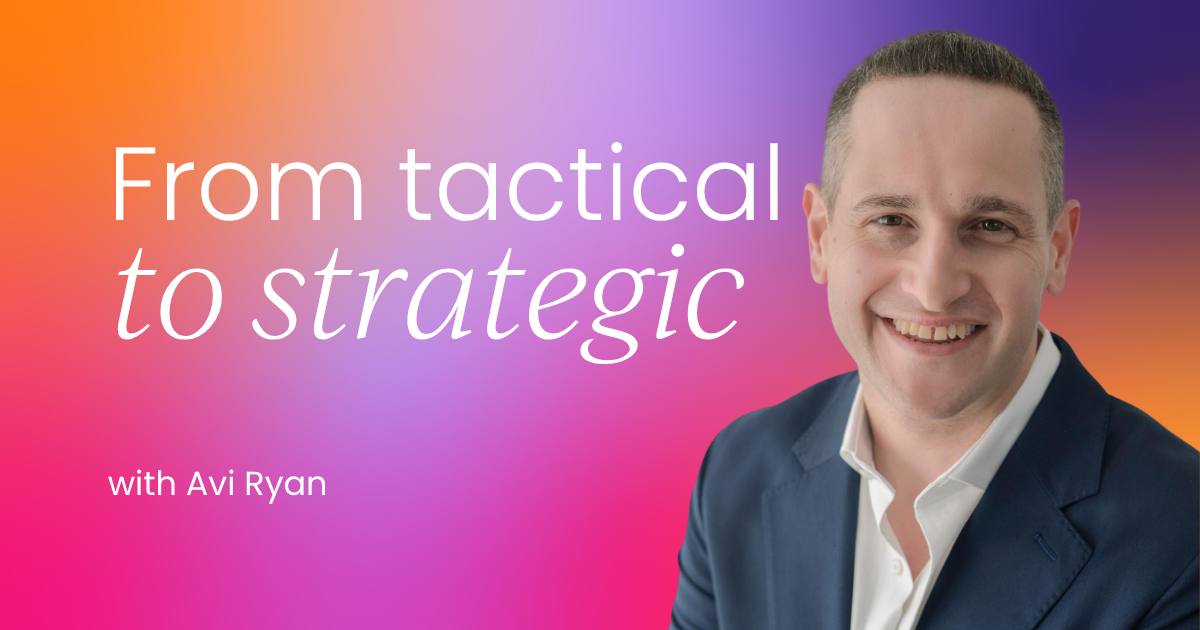
The three solutions that actually work
Here's the good news. These problems are solvable. And the companies that are solving them aren't necessarily the ones with the most advanced AI tools or the biggest technology budgets. They're the ones operating on three core principles.
Solution one: clarity
Companies with one aligned North Star goal across all business units make decisions 2.4 times faster than siloed organizations. In a market moving this fast, the speed at which you can make and execute decisions matters enormously. Clarity on direction is what enables that speed.
But clarity has two dimensions. Internal clarity is about alignment. It means everyone in the organization, across sales, marketing, customer success, and product, is oriented toward the same goal. When that's in place, decisions happen faster because there's less negotiation about what matters.
External clarity is about your market. Most companies are only reaching about five percent of their potential market. External clarity means understanding precisely who your customers are, what actually matters to them (not what you assume matters to them), and being genuinely specific about what you offer and why someone would choose you over the alternatives.
A useful example here is a company I worked with that had been operating for about a hundred years. They'd survived wars, recessions, and global economic shifts. But they were suddenly facing a threat they hadn't encountered before: irrelevance.
Digital-native competitors were entering their market, scaling fast, and capturing market share from a customer segment that had never had a strong relationship with the legacy brand.
The typical response in that situation is to push harder on transactions, automate more, and cut costs. They took a different approach. They used AI to build genuine clarity on which customers were shifting toward digital competitors and, more importantly, why. For a significant portion of that segment, particularly younger customers, financial transparency and sustainability were the deciding factors.
So they built an AI tool that translated every transaction into a tangible representation of its impact. It wasn't a marketing campaign. It was a product change grounded in real customer insight. That's what clarity does. It gives you direction, and it gives you differentiation. And over time, it tends to outperform resources.
Solution two: adaptability
AI-native organizational redesign can capture three times more value than traditional optimization. That's a significant gap, and it comes down to a fundamental shift in how we think about competitive advantage.
Speed still matters. But scope matters just as much. In a market where no one has a perfect playbook, the ability to learn faster than the market is changing may be more valuable than any specific capability you currently have.
Adaptability in practice has two components. The first is signal recognition. Staying genuinely close to your customers, understanding their intent, their behaviors, and the shifts happening in the market, and then connecting those signals to your business goals. This is where AI can do real work. Bringing in signals from across the market and translating them into something actionable.
The second component is a fast experimentation loop. Test, learn, decide, adopt, and test again. This sounds simple, but most organizations have friction built into every stage of that cycle. Approval processes slow things down. Risk aversion discourages experimentation. Organizational hierarchy makes it hard to move quickly on what you're learning.
When you add an AI layer on top of an organization that was designed for a slower, more predictable market, you don't automatically get speed. You often get more complexity. The companies moving fastest right now are the ones that have addressed the underlying organizational design, so that AI amplifies agility rather than adding another layer of noise.
 Daniel Johnson
Solution three: collaboration
This one might sound softer than the first two, but it's where the real operational leverage lives.
The companies winning right now have built collaboration as an engine, not just a value. Collaboration across teams, collaboration with customers, and collaboration with AI as an actual operational infrastructure rather than a set of disconnected tools.
Start with internal collaboration. There's a well-known tension in most B2B organizations between brand and performance, between long-term and short-term, between sales and marketing. These tensions are real, and they're costly. When teams are working from different dashboards, different KPIs, and different definitions of success, execution slows down, and decisions get harder.
Aligning teams around a single business goal, with shared metrics and shared visibility, removes a significant amount of that friction. Decisions get faster. Execution becomes more consistent. And the organization starts moving in one direction rather than several at once.
The external dimension is where things get interesting. Most companies are using AI to talk to customers. Fewer are using AI to listen to them. That's the shift worth making. Customers aren't searching for products anymore. They're searching for answers. The company that can understand what those answers need to be, before the customer has articulated the question directly, has a meaningful edge.
That hundred-year-old company I mentioned earlier got this right. They didn't commission a research report or run a focus group. They used AI to systematically review customer conversations, identify patterns, and understand the reasoning behind customer behavior. They listened to the market before most of their competitors even knew the signal was there.
The question for your business is how quickly you can connect market signals to action. Not to analysis. Not to a strategy presentation. To actual product decisions, customer experience changes, and go-to-market adjustments. That speed of translation is where the competitive difference is being made right now.
Putting it together: what this looks like in practice
When you look at the three solutions together, a clear framework emerges.
Clarity is your North Star. It aligns the organization, focuses resources, and makes differentiation possible in a crowded market. Without it, you're making decisions reactively, and you're likely to keep making the same ones.
Adaptability is your competitive edge. The market is moving faster than any single playbook can accommodate. The organizations that are winning aren't the ones that got the strategy exactly right. They're the ones that learned faster than everyone else and adjusted accordingly.
Collaboration is what creates momentum. Alignment without execution is just a slide deck. Collaboration, across teams, with customers, and with AI as a genuine operational layer, is what turns clarity and adaptability into actual revenue growth.
These three things compound. Clarity makes collaboration more effective because everyone knows what they're working toward. Adaptability makes clarity more durable because you're continuously updating your understanding of the market. And collaboration makes adaptability faster because you're not learning in isolation.
The actions worth taking back to your business
When you think about applying this to your own organization, a few questions are worth sitting with.
Do you have one aligned business goal that genuinely spans sales, marketing, customer success, and product? Not a goal that lives in a strategy document, but one that actually shapes how each team makes decisions day to day. If the answer is no, that's the most important thing to fix. Companies that operate with that kind of alignment make decisions significantly faster, and in the current market, decision speed is a real competitive advantage.
How does your organization treat experimentation? Is trying something new and failing seen as a problem, or is it recognized as part of how the business learns? Removing friction from experimentation processes is one of the highest-leverage things you can do right now, because the ability to test and learn quickly is what adaptability actually looks like in practice.
And finally, are you using AI to listen to your customers, or just to talk to them? There's a meaningful difference. Listening means systematically collecting signals about customer intent, behavior, and reasoning, and feeding those signals back into product decisions and go-to-market strategy. Most organizations are still primarily in broadcast mode. The ones shifting toward genuine listening are building an advantage that compounds over time.
The real challenge isn't technology
Here's what I keep coming back to, in every conversation I have with businesses navigating this moment.
Technology is accessible to everyone. The tools are out there. The data is available. AI is no longer a differentiator in itself, because your competitors have access to the same capabilities you do.
What differentiates companies right now is organizational adaptability. The ability to move fast when the market shifts. The ability to make clear decisions without getting stuck in internal friction. The ability to listen to customers and act on what you hear before the window closes.
Ninety-five percent of Dutch businesses are experimenting with AI. Only five percent are seeing real business value. The gap between those two numbers isn't a technology gap. It's a clarity gap, an adaptability gap, and a collaboration gap.
The companies that close that gap, and do it deliberately, are the ones that will look back on this period as the moment they pulled ahead. The ones that don't will find that AI amplified exactly what was already there, for better or worse.
The market is moving too fast for perfection. But it's not moving too fast for clarity, adaptability, and strong collaboration. Those three things are within reach for any organization willing to prioritize them.


Revenue operations alliance insider
Thank you for subscribing
Level up your revenue operations alliance career & network with revenue operations alliance experts.
An email has been successfully sent to confirm your subscription.
 Follow us on LinkedIn