
 6 min read
The headline most revenue leaders have felt over the last six to twelve months is simple: AI won't fix a broken sales process, especially when it's built on incomplete data.
The pressure is real. CEOs are asking for it. Sales reps are asking for it. Everyone across the organization is looking to revenue leaders to figure out how AI can make teams more efficient, more predictable, and ultimately more effective.
The potential across forecasting, pipeline management, and deal execution is significant. Every one of those areas can be transformed by the right application of AI.
Putting AI into practice is genuinely hard.
The process of figuring out how to implement it well is something the industry is still working through.
After conversations with over two thousand sales leaders, one finding stands out: 60% of revenue leaders don't trust their data.
It usually comes down to everyday friction. Sales reps don't update their CRM.
Conversations happen with customers that are never logged anywhere. Teams are asked to live in Salesforce for pipeline, Gainsight for customer data, Tableau for product usage, and a handful of other tools depending on what they need to know.
The honest truth is that top reps would rather spend time with a customer than head back to their desk to update the CRM.
Often, that's the right call. The relationship matters, but the consequence is that data ends up scattered, siloed, and sometimes absent from any system at all. That creates friction with the existing workflows teams rely on.
There is a pattern in first conversations with new prospects.
Five things come up almost every time:
- Our CRM data is in poor shape, and our reps don't update it.
- Not all of our team's calls are recorded.
- Key customer data is sitting in spreadsheets and external systems.
- We can't replicate what makes our top reps successful across the rest of the business.
- We know what our customers and reps are saying, but we don't know what they're actually doing.
That last one shows up in situations like a customer call where the prospect says they're ready to move forward, but the deal is single-threaded, and the contact doesn't have the authority to make the decision. Only half the picture is visible.
How to deliver the right signal at the right moment
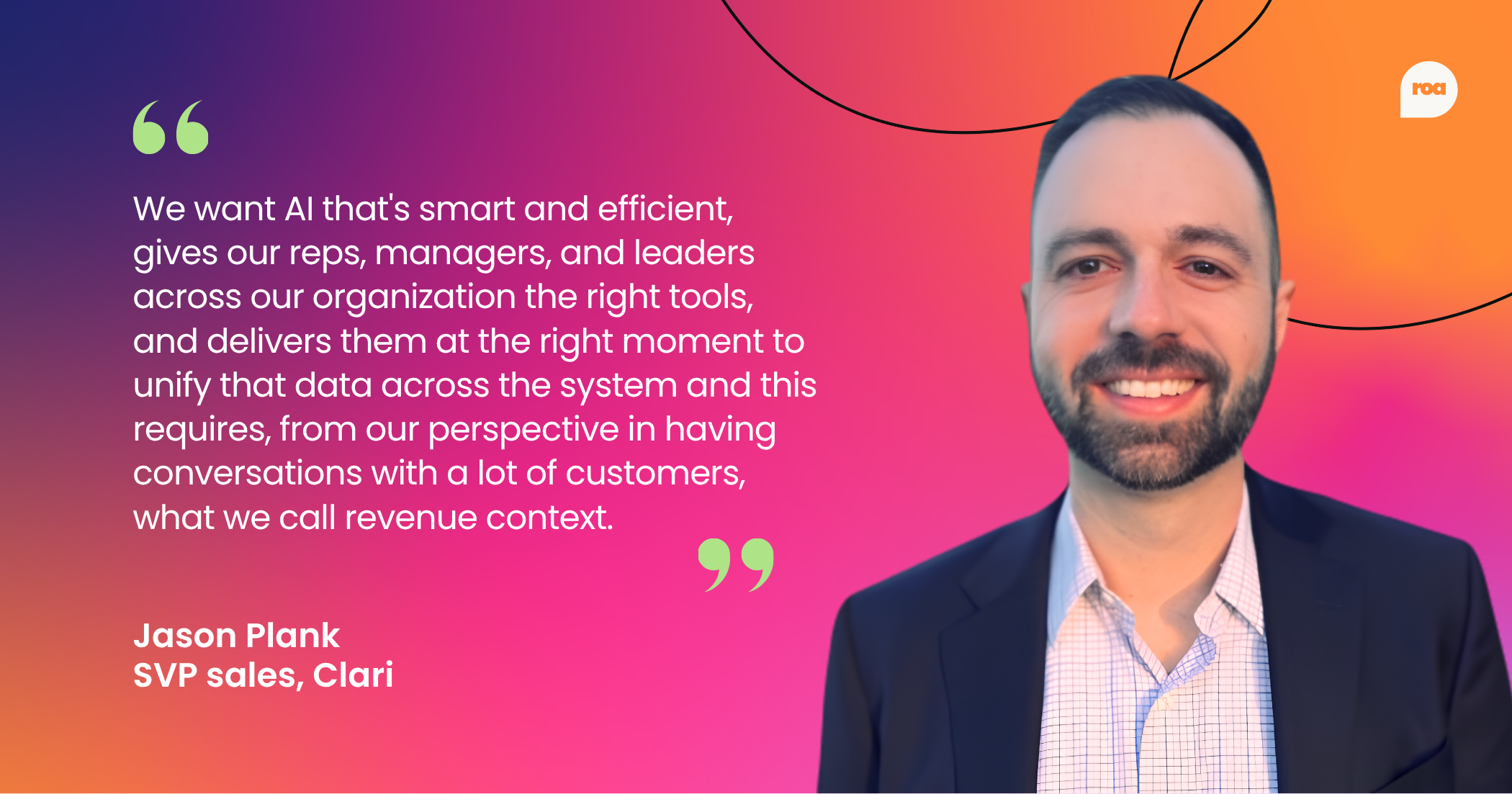
What revenue leaders are really trying to achieve is straightforward: deliver the right signal to the right team at the right moment. Smart, efficient, putting the right information in front of reps, managers, and leaders exactly when they need it.
To get there, data has to be unified across the system. We call it revenue context.
Revenue context means bringing all revenue data into a time-series database that not only unifies disparate sources but also surfaces actionable insights.
Should a rep reach out to a specific person inside the account? Should the focus be on driving adoption at a particular team level?
Revenue context is what makes that kind of guidance possible. It's the foundation for generating scalable, repeatable revenue.
The inputs that feed good AI
There are three categories of input that determine whether AI in a revenue context actually works:
- The first is customer engagement: emails, meetings, recorded calls, and mutual action plans, all automatically collected. The key principle for any sales leader evaluating AI tools is this: how does the system automate the data collection that feeds insights? Without automated collection, nothing useful happens, because the alternative is relying on sellers to do extra administrative work that pulls them away from customers.
- The second is external data. This is the area where most teams are blind, bouncing between multiple systems to piece together a picture. Customer usage data, product usage, billing data, and anything sitting in external systems that isn't in front of reps. If sales reps or leaders have to switch between solutions to tell the full story of an account or opportunity, AI becomes less effective and workflow suffers.
- The third is CRM data. Not the most exciting topic, but still home to some of the most important data that drives AI. A system that can pull data from a CRM and push enriched data back into it matters for both internal use and for providing counterparts in finance, marketing, and customer success with what they need.
When all three are brought together and layered with revenue context, including cadences, AI insights, workflows, time data, and recommended actions, the outcomes most revenue leaders are looking for start to become achievable.
Revenue context isn't just about a single deal or account. It's about managing the business from the top down, with alignment from the individual sales rep all the way up to the executive level.
Running a 13-week cadence with AI
One area where this matters most is cadence.
The information delivered to a rep or manager when they open their system should match the week of the quarter they're in and the focus that week demands. Take QBRs as an example.
Those conversations involve looking back at the prior quarter, identifying what worked and what didn't, and optimizing for the next one. AI should deliver insights that enhance those conversations, not just report what happened.
Using AI to coach and guide next steps
The second big area is using AI to coach and guide the next steps of a deal.
The approach is to take unstructured data and ask: How does this match the patterns observed in closed-won and closed-lost opportunities? If a risk pattern appears in a rep's deal, an agent can review every deal in that rep's history that had the same risk and closed won, and then recommend specific actions to take.
 Ash Finnegan
That's where the biggest near-term impact for reps is likely to come over the next two years: by looking at historical patterns and delivering recommended next actions based on what's worked before.
The results are measurable.
Eleven percent increases in win rates, better forecasting accuracy, and better coaching. Managers and reps can see around corners in their deals. Instead of jumping into Slack or Teams to ask the team how to handle a specific situation, AI can offer guidance directly.
A productivity shift is already evident in internal headcount data, and it will continue across the industry over the next five to ten years.
Back in 2020, rep attainment sat at around a million dollars. That same rep is now being asked to carry roughly two million in quota. The tools exist to support that expectation.
Manager coverage is shifting too. The traditional ratio of six to eight reps per manager is moving toward ten to twelve. With AI embedded throughout the revenue process, managers can cover more ground. The agents and assistants analyzing unstructured data and recommending actions aren't replacing managers; they're giving managers the capacity to do more.
More pipelines can be converted faster, with fewer resources. That drives down the cost of customer acquisition, and AI plays a significant role in surfacing the right recommendations to achieve it.
 Thomas Doherty
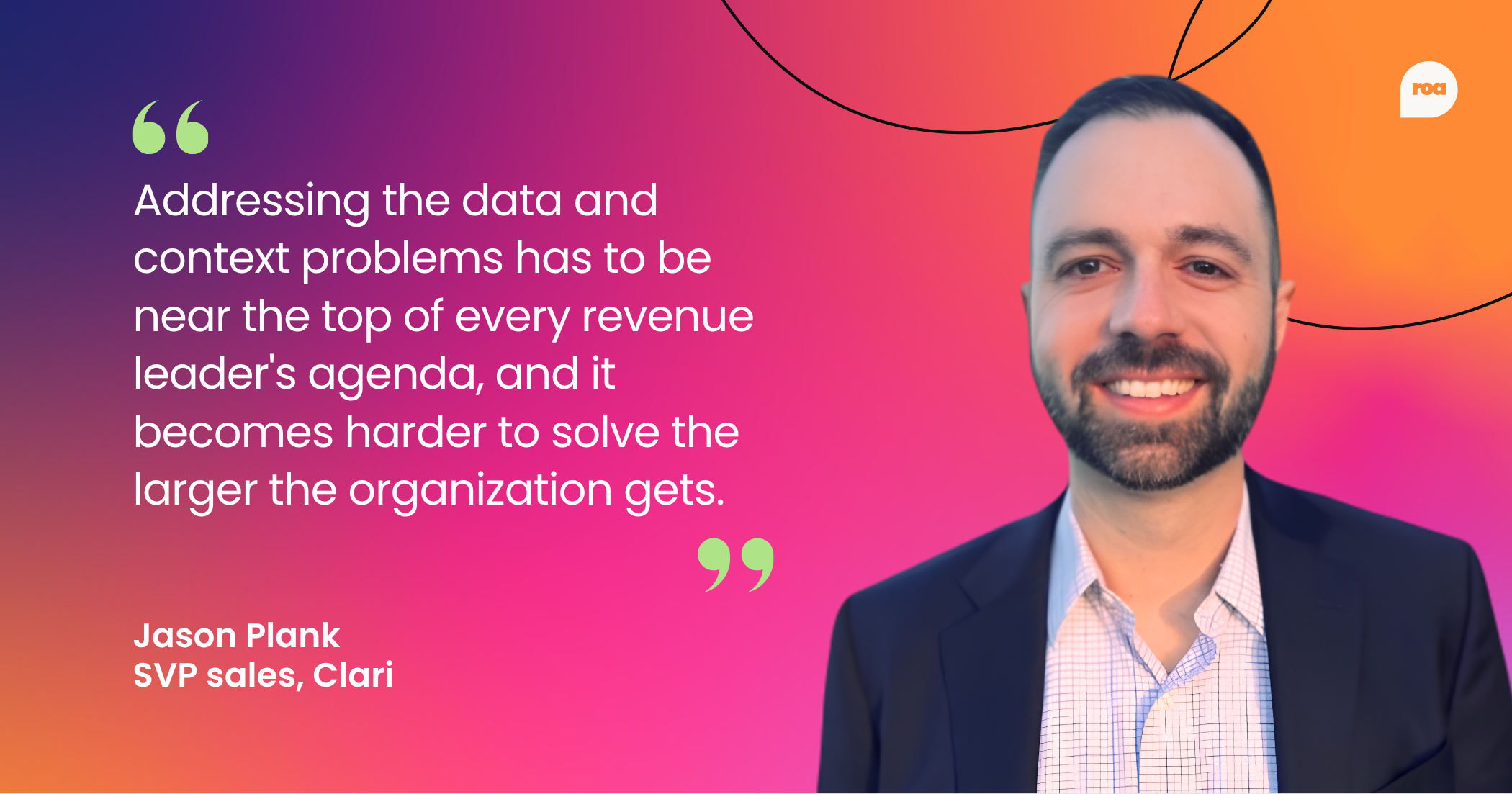
Addressing the data and context problems has to be near the top of every revenue leader's agenda, and it becomes harder to solve the larger the organization gets.
Trusting AI to make smarter decisions depends entirely on the data fed into the system and the context provided to users. Get that foundation right, and the rest of the AI promise starts to become real.


Revenue operations alliance insider
Thank you for subscribing
Level up your revenue operations alliance career & network with revenue operations alliance experts.
An email has been successfully sent to confirm your subscription.
 Follow us on LinkedIn