

 9 min read
Back in the day, the term was "sales operations," but increasingly, we're seeing a shift towards "revenue operations" as a more holistic approach. So, what's the difference?
Well, RevOps takes the traditional Sales Ops functions and expands them to include Marketing Ops and Customer Ops as well. It's all about looking at the entire customer lifecycle, from lead generation to retention and renewal.
You see, the customer journey doesn't start when a sales rep picks up the phone or sends the first email. It begins much earlier, with your marketing efforts to attract and nurture leads.
It also doesn't end when the deal is closed – it's crucial to ensure that your customers are happy and continue to renew their contracts with you.
By bringing these different functions under the RevOps umbrella, we can create a seamless, data-driven approach to driving revenue growth. It's not just about hitting your sales targets; it's about optimizing every step of the process to maximize efficiency and profitability.
 Alysson Pehoski
The RevOps vision and model
So, what does a RevOps team actually do? Let me break it down for you:
📈 Operations: This is the backbone of the team, handling everything from RFPs and proposals to lead management and budgeting. It's all about ensuring the smooth running of the entire revenue-generating machine.
🔍 Analysis: Imagine having a single source of truth for all your sales data – that's what the analysis function is all about. We make sure that the numbers you're looking at, whether it's pipeline, forecasts, or goal attainment, are consistent and reliable across the organization.
🛠️ Tools: RevOps is responsible for evaluating, implementing, and optimizing the technology stack that supports your sales, marketing, and customer success teams. We ensure that these tools are integrated, providing a seamless user experience and maximum ROI.
🧠 Enablement: This is where we really help your sales reps excel. We develop onboarding programs, continuous training, and content strategies to equip your team with the knowledge and skills they need to close deals and delight customers.
💰 Compensation: The sweet spot – making sure your sales reps are properly incentivized to sell in alignment with your company's goals. We work closely with finance to design comp plans that drive the right behaviors and keep your team motivated.
By focusing on these five key functions, RevOps can help improve revenue, increase efficiency, and enhance forecasting accuracy. It's a holistic approach that brings together the various moving parts of your revenue engine.
Of course, the specifics of the model may vary depending on the stage and needs of your organization. But the underlying principles remain the same: to optimize every aspect of the revenue generation process and set your sales team up for success.
Melissa Murray Bailey
Key metrics
Now, let's talk about the metrics that really matter when it comes to revenue operations. These are the key indicators that will help you understand the health of your sales organization and make informed decisions.
- Sales cycle time: How long does it take, on average, to close a deal?
Understanding this metric can help you forecast more accurately and identify bottlenecks in your sales process.
- Win rate: What percentage of your qualified opportunities are you closing?
This is a critical metric for understanding the effectiveness of your sales team and the quality of your pipeline.
- Average deal size
Keeping tabs on the average value of your deals can provide insights into your target market, pricing strategy, and upsell/cross-sell opportunities.
- Cost of customer acquisition (CAC)
This metric helps you understand the investment required to acquire new customers, which is crucial for maintaining healthy margins and profitability.
- Annual revenue
Of course, the ultimate measure of success is your overall revenue growth. By tracking this metric, you can assess the impact of your revenue operations strategies and make adjustments as needed.
Now, I know what you're thinking: "But Carol, my Salesforce data is a mess! How can I trust these numbers?" You're absolutely right – clean, consistent data is the foundation for accurate reporting and insightful analysis.
That's why one of the first tasks for a RevOps team is to ensure that your Salesforce instance (or whichever CRM you're using) is properly configured and maintained.
We'll work with your sales and marketing teams to establish data governance protocols, implement best practices, and train everyone on proper data entry and usage.
Trust me, having that single source of truth will make all the difference when it comes to tracking and optimizing your revenue operations.
Rebecca Stewart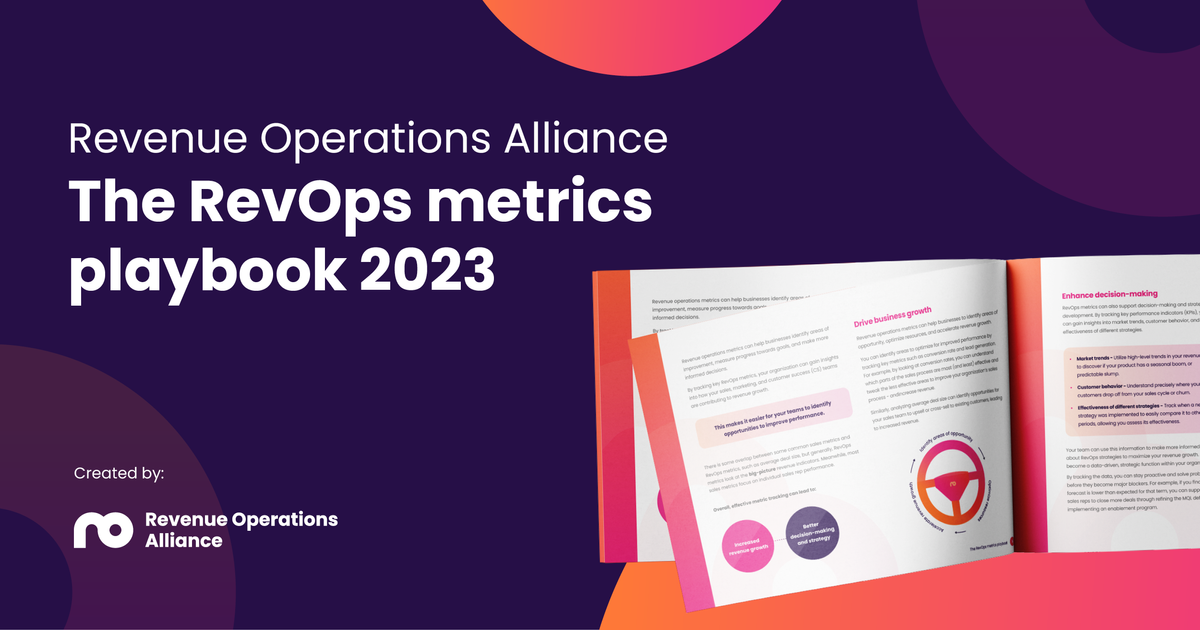
Planning for success
Alright, now that we've covered the basics, let's talk about how to actually plan for success.
One of the most important aspects is setting realistic and achievable sales quotas. I can't stress this enough – getting this right is crucial for motivating your team and driving the right behaviors.
Here's how I approach it: first, I make sure that the overall ARR (annual recurring revenue) goal is aligned with the company's growth objectives. Then, I assign quotas to individual reps, but I always build in a buffer.
Don't just rely on open headcount as a buffer – that's a risky move, as you never know when those new hires will actually start producing.
Instead, I recommend calculating a bottom-up quota that adds up to the company's target, with a healthy buffer on top. And here's the key:
Another important piece is forecasting. I know it can be a challenge to get your sales team to commit to a number, but it's crucial for driving accountability and visibility. By aligning your RevOps forecast with the sales team's, you can identify discrepancies and work together to improve the accuracy of your projections.
And speaking of the sales team, it's vital to have a strong bench of talent. Always be in hiring mode, even if you don't have an immediate need. That way, when someone does leave, you've got a ready-made pool of candidates to draw from.
Rebecca Stewart
Leveraging data to forecast and optimize
Remember those three key metrics I mentioned earlier? Sales cycle time, average deal size, and win rate? Well, these are the foundation for building a data-driven forecasting model.
If I know my average deal size is $50,000, my win rate is 30%, and my sales cycle is 90 days, I can calculate the pipeline I need to hit my revenue target. It's a simple formula, but it gives me a much more accurate picture than relying solely on my sales team's gut feelings.
Of course, it's not just about the numbers – understanding the quality and source of that pipeline is also crucial. If I have a bunch of low-quality leads that are taking forever to close, that's going to skew my forecasts. But if I can identify the high-value, fast-moving opportunities, I can focus my team's efforts accordingly.
That's where RevOps can really shine. By analyzing the data in Salesforce and other tools, we can uncover insights that help sales reps prioritize their time and energy.
Maybe we notice that leads from a certain marketing campaign convert at a much higher rate – that's valuable intel that can inform your go-to-market strategy.
Hannah Pegram
Driving rep performance
Now, let's talk about something near and dear to my heart: sales rep performance.
One of the key responsibilities of RevOps is to ensure that your sales team is operating at peak efficiency, and that starts with understanding how they're performing as individuals and as a group.
I like to think of a "healthy org" as one where the sales reps follow a bell-curve distribution. You've got your high performers at the top, your middle-of-the-road reps in the bulk of the curve, and your low performers at the bottom.
The risk with organizations that are too heavily skewed towards the extremes is that you become overly dependent on a few star players. If one of them leaves, it can create a massive hole in your revenue, and on the other end, if you've got too many underperformers, it can really drag down your overall team metrics.
So, as a RevOps leader, I'm constantly analyzing rep-level data to identify areas for improvement.
Where are reps getting stuck in the sales process?
What activities are driving the most pipeline creation?
How can we equip them with the training and tools they need to succeed?
By taking a data-driven approach to sales rep performance, we can uplift the entire team and create a more sustainable, predictable revenue engine.
Joe Aurilia Jr.
Optimizing lead response and conversion
One final area I want to highlight is the importance of lead response and conversion optimization.
Think about it – if your sales reps aren't quickly following up on those marketing-generated leads, you're leaving a ton of potential revenue on the table.
Then if those leads aren't being properly scored and routed, your reps might be wasting their time on low-quality opportunities.
That's why RevOps plays a crucial role in this part of the process. By analyzing Salesforce data, we can identify bottlenecks in lead response times and work with the sales team to address them.
Sometimes, it's as simple as setting up a daily report that calls out the leads that haven't been touched – once the reps know they're being monitored, their response times tend to improve dramatically.
We also work closely with marketing to fine-tune the lead scoring and routing models. By ensuring that only the hottest, most sales-ready leads are being passed to the reps, we can maximize conversion rates and pipeline velocity.
It's not just about the initial conversion – RevOps also keeps a close eye on renewal risk. After all, what's the point of closing all these new deals if you can't retain your existing customers?
By monitoring key metrics like churn and customer health, we can proactively identify at-risk accounts and work with customer success to keep them happy and loyal.
Wrapping up
Well, there you have it!
From defining the right metrics to planning for success, leveraging data-driven insights, and optimizing rep performance and lead conversion – RevOps is the secret weapon that can help you crush your revenue targets.
Of course, implementing a successful RevOps function isn't something that happens overnight. It requires a strategic, cross-functional approach and a deep commitment to data-driven decision-making.
But trust me, the payoff is more than worth it.


Revenue operations alliance insider
Thank you for subscribing
Level up your revenue operations alliance career & network with revenue operations alliance experts.
An email has been successfully sent to confirm your subscription.
 Follow us on LinkedIn