


Most revenue leaders are running the same play they've been running for years. Hire more reps. Buy more leads. Go to more events. Spend more on marketing. And for a long time, that playbook worked well enough.
But every one of those levers is getting more expensive and less predictable at the same time. You're probably feeling that right now. If you're being asked to grow faster this year with the same or fewer resources, you're in good company. That's the reality for almost every revenue team I talk to.
So the question worth sitting with is this: what if your next source of pipeline is already out there, and your buyer is already in it?
The 70% problem
Here's something we all know but rarely act on. Seventy percent of the buyer journey happens before a prospect ever enters your funnel. These decisions are forming outside of your control, in spaces you probably aren't present in.
They're happening in Slack channels when someone asks, "Does anyone use this vendor?" They're happening in buying committees that build shortlists before a single demo gets booked.
They're happening in mentoring relationships and executive roundtables where your category gets discussed regularly, and your name either comes up or it doesn't.
Build, buy, or borrow
You're probably familiar with the build-buy-borrow framework when it comes to technology or market entry. The same logic applies directly to community.
You can build one. A customer ecosystem, an advisory board. Solid long-term play, but it takes 18 to 24 months to get any real traction. You can buy one. A media property, a newsletter, an existing audience. Expensive, and rarely the right move for a revenue team trying to move the needle this fiscal year.
Or you can borrow one. Go to where your buyer already gathers, where they've already invested their trust, and where they're already making the early stages of purchasing decisions.
Places like RevOps Alliance, Wednesday Women, PayTech Women. Professional and industry associations that your best prospects already belong to. These communities took decades to build. You can get inside them next quarter.
The borrow strategy is the fastest path to pipeline, and it's the one that almost nobody is doing systematically. That's what I want to walk you through.
For expert advice like this straight to your inbox, sign up for Pro+ membership.
You'll also get access to 100+ hours of exclusive video content, a complimentary Summit ticket, and so much more.
So, what are you waiting for?
Introducing the DEER framework
DEER stands for Develop, Engage, Activate, Retain. It's a system that works whether you're building your own community or operating inside one you've borrowed.
Each letter maps to an outcome your revenue team actually cares about: pipeline, deal acceleration, and retention.
Let's go through each one.
Develop: find the right communities and the right people within them
There are two main buckets here, and both are worth your attention.
The first is peer professional communities. Think RevOps Alliance, Win/Loss communities, GTM-specific networks. These are places where your buyers go to learn, to vent, to get advice, and to get vendor recommendations.
A GTM software company recently tapped one of these networks to find advisors for a new AI offering. That relationship started inside a borrowed community, not through traditional outbound, and not through something they built themselves.
The second bucket is the more underutilized one: nonprofits and industry associations. Women in Revenue. PayTech Women. The National Optometry Association. The vertical associations that your buyers actually belong to. If you sell optometry software, you might be surprised how many companies in that space never think to engage with the optometry association.
To make this concrete: before speaking at this event, I mapped out the associations that would be most relevant to each of the other speakers and sponsors. Aventive's buyers are correctional officials, so the American Correctional Association is where those buyers vest their trust.
Kinnini's buyer is the CIO, which points to the Society for Information Management. Shook sells to L&D professionals, which means the Association for Talent Development is where their buyers go for professional development and education.
Every single one of those associations has a flagship member program worth sponsoring. Might be a mentoring program, a certification track, or a leadership series. That's where the Engage step comes in.
 Revenue Operations Alliance
Engage: climb the ladder, don't just plant a logo
Engagement is a ladder, and most companies show up at the first rung and stop. They put a logo on a banner, call it a sponsorship, and wonder why nothing happens.
The real ladder has three rungs.
The first is participation. Contribute content, speak at events, become a known name in the community as a peer and an expert. The emphasis here is on peer and expert, not on vendor pitching whatever you sell.
The second is sponsorship. Sponsor events, chapter programs, content series. A strong entry move is offering complimentary tickets to the association's annual conference, maybe even a small travel stipend. You're giving before you ask, and you're associating your brand with something these members genuinely care about.
The third rung is owning the moment. This is the naming rights play, and it's the highest leverage move in the entire framework. Stop being a vendor on the edge of a community and become part of its actual identity.
Here's what that looks like in practice. At Art of Mentoring, we sponsored the PayTech Women Mentoring Program. PayTech Women is an association of women executives in fintech and payments, with members from some of the largest companies in the space.
Because of the success of that program, we were invited to present to their board and speak at their annual conference. Board members from JPMorgan Chase, Mastercard, and major fintechs. We didn't pitch our way into that room. We earned it by owning the program their members valued most.
Another example from a different industry: Postal, a corporate gifting platform, partnered with Wednesday Women, a community of senior women executives, and co-created a bespoke event series that included custom-curated gifts.
They were literally demonstrating what their platform does to the attendees. That partnership is still running two years later. Mission alignment, bespoke design, measurable outcomes.
Activate: structure the peer moments, don't wait for them
Activation is where community presence starts converting into pipeline. And the key insight here is that peer-driven buying moments don't just happen organically. You can structure them.
There are three moments worth understanding.
The first is the committee vetting you before you're in the room. Procurement committees ask peers about vendors before a salesperson ever gets a meeting. If you're not inside the community, you don't make the shortlist.
The second is the dark social gut check. A buyer posts in a Slack channel or association forum asking if anyone's used your product.
That thread moves or kills your deal entirely outside of your CRM, outside of your knowledge, outside of your control. Your rep might mark that opportunity as "no budget" without ever knowing the real reason it went cold.
The third is the advisory board vouch. A board member personally tells a prospective buyer, "we use them, they're good." That short-circuits the entire evaluation cycle. Community-sourced deals close faster because trust is established before the first sales conversation, not during it.
To structure these moments, give your best community relationships a tiered path to do more with you. Allies are your entry level: they give testimonials, make quick intros, are easy to activate, low ask.
Strategic partners co-market and co-sell, show up at events, contribute to your content, and introduce you to their network deliberately. Founding champions are the highest tier. They help build new offerings and open rooms you couldn't get into alone. When a committee is vetting you before you even know a deal exists, it's the founding champion doing their job.
Here's the practical part: these tiers map directly to your borrowed communities. Your RevOps Alliance connection can become an ally. Your PayTech Women board contact can become a founding champion. And you can build this structure in 30 days using relationships you already have.
 Spencer Dent
Retain: community presence as your competitive moat
Retain is where community presence becomes something your competitors can't easily replicate. And it's the argument worth taking back to your leadership team.
In most mature categories, products are more similar than sales teams want to admit. When your product is relatively comparable to a competitor's, the tiebreaker often isn't a feature. It's trust. It's presence. It's who showed up at the association conference, who sponsored the mentoring program, who's known by name inside the community your buyer belongs to.
Consider two vendors with similar features. Vendor A has no community presence. Vendor B sponsors the annual mentoring program, presents at chapter events, and is a familiar name in the buyer's world. Vendor B wins. Often.
And here's the retention piece that makes this a genuine moat: leaving Vendor B doesn't just mean switching software. It means leaving a network. Their colleagues know Vendor B. Their association conference features Vendor B. Their mentoring program carries Vendor B's name. Switching has a social cost, and that changes the calculus entirely.
There's a reframe here that I think is worth sitting with. Client satisfaction is passive. You survey it, report on it, celebrate your NPS score. But satisfied customers don't necessarily become advocates. Invested customers do.
Investment means they put something in. Time in a mentoring relationship that carried your brand. A seat at a conference you sponsored. A peer intro they made on your behalf. When that happens, they're invested in your success. Develop, Engage, Activate, and Retain through community, and you're creating investment. That's a fundamentally stickier thing than satisfaction.
The flywheel this creates
When you put DEER together, it creates a compounding system. Community participation leads to advocacy. Advocacy leads to referrals and new customers. New customers, retained and expanded, feed back into more community presence. Every community relationship you develop today is an asset that pays dividends across pipeline, deal velocity, and retention simultaneously.
This is the difference between community-led growth as a real GTM motion and community-led growth as a marketing side project. The motion is deliberate, structured, and measurable.
How to measure it
Three categories of metrics are worth tracking here, but two deserve the most attention.
The first is time-to-close delta: the difference in sales cycle length between community-sourced deals and your average opportunity. In our experience, community-sourced deals close faster because trust is already established. Tracking this delta gives you a concrete business case for the investment.
The second is advocate-to-deal ratio: how many active advocates you need to generate one deal. This helps you understand the scale of the community motion you need to build and gives you a target for how many relationships to develop and tier.
Both of these metrics connect community activity directly to revenue outcomes, which is exactly the conversation you need to have with your board or your CFO.
 Dominic Grounsell
Four things you can do on Monday
You don't need to wait for a strategy offsite or a new budget cycle to start. Here's what you can do this week.
First, map the communities your buyers belong to. Not where you think they should be, but where they actually spend their time. Industry associations, peer networks, professional communities. Do the research.
Second, pick one of those communities and show up. Participate, contribute, offer tickets to an upcoming event. Start building presence as a peer, not as a vendor.
Third, find their highest-value member program. This takes some digging. It might be a mentoring program, a certification track, or a leadership series. It often hasn't been sponsored before, which means there's an opening. That's your naming rights opportunity.
Fourth, identify your 10 most invested customers. Not your happiest, but your most invested. The ones who are genuinely bought into your success. Give them a formal tier and give them a path to do more with you.
The shift that matters
Traditional revenue thinking leans heavily on more reps, more spend, more activity. Modern revenue thinking leans into more trust, more relationships, more advocates.
The most scalable growth engine isn't your sales team. It's a community of customers and a borrowed community of prospects who trust each other more than they trust your marketing.
Develop the right relationships. Engage with genuine value before you ask for anything. Activate those relationships into pipeline and peer-driven buying moments. Retain customers by making community presence part of your competitive identity.
The companies that win over the next decade won't necessarily have the biggest funnels. They'll have the strongest networks. And the good news is, those networks already exist. Your buyers are already in them. The question is whether you are too.
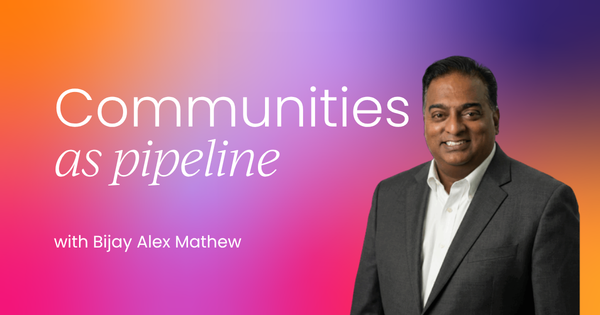
Bijay Alex Mathew, Chief Revenue Officer, Art of Mentoring, gave this talk at our Chief Revenue Officer Summit, Austin, 2026.


Revenue operations insider
Thank you for subscribing
Get exclusive RevOps insights, expert tips, tools, and networking – at no cost.
An email has been successfully sent to confirm your subscription.
 Follow us on LinkedIn


Start the conversation
Become a member of Revenue Operations Alliance to start commenting.
Sign up now