

 5 min read
Tana Jackson is four weeks into her role as Head of Revenue Operations at Motorola Solutions.
She has already traveled to Florida, returned from Portugal, and is preparing to fly to Australia. She has sat through SKOs, met the extended global team, and begun building the kind of picture that only comes from being in the room.
She has not touched the CRM, not yet, and that restraint is deliberate.
That is one of the more underrated skills in revenue operations.
The case for slowing down to speed up
There is pressure that comes with stepping into a senior RevOps role. You were hired because you have experience. You can see the problems within days. The instinct is to move fast, make changes, and start proving your value.
Tana's advice runs counter to that instinct, at least in the beginning.
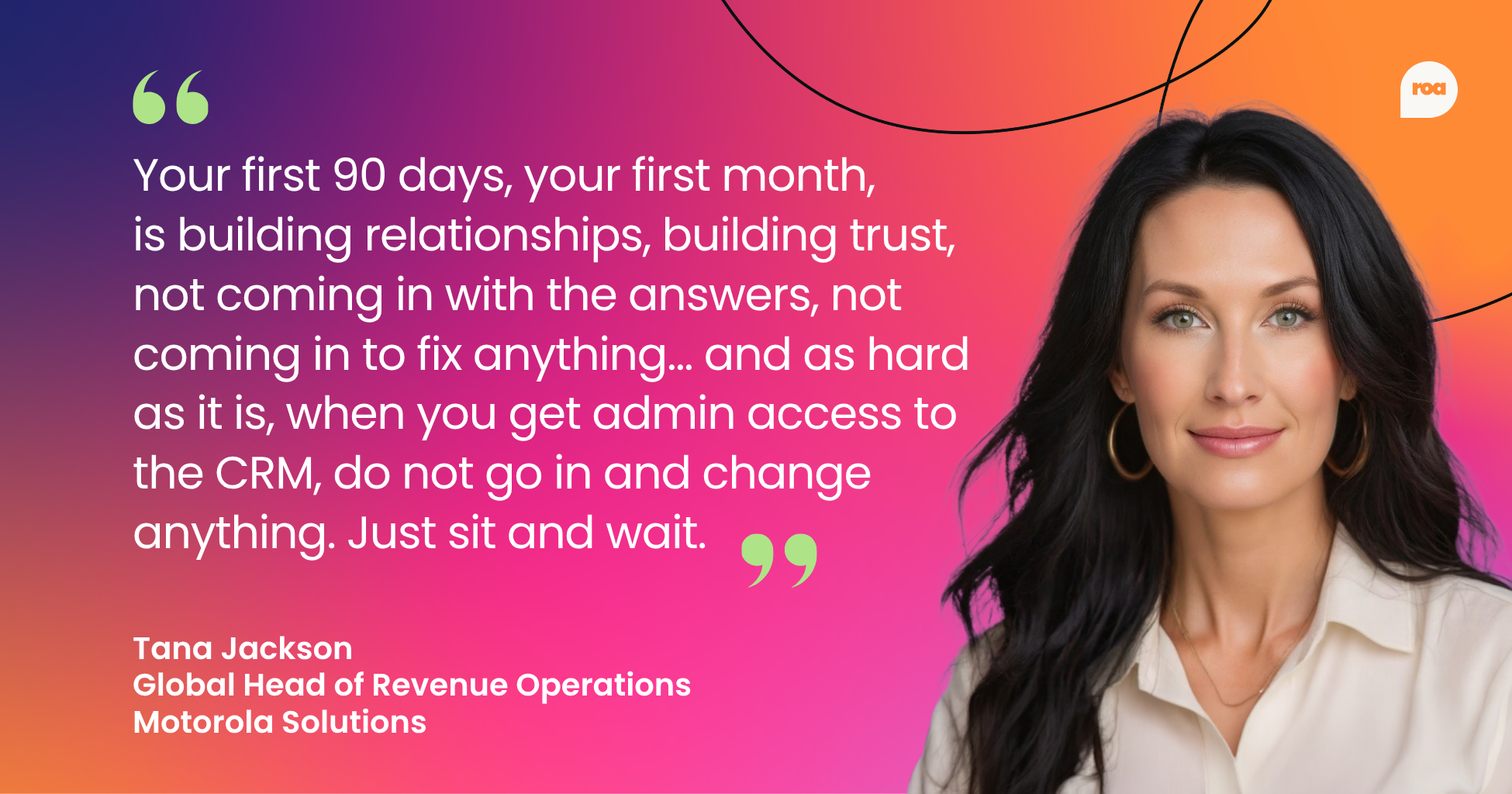
This is not passivity but a structured approach to gathering intelligence before acting on it.
Tana keeps a detailed Excel tracker of everything she observes. Found this. See this. Recognize this. Notice this. It becomes the foundation for every decision that follows.
The question you should stop asking
One of the more practical pieces of advice Tana offers is about the word "why."
Asking why, even with genuine curiosity behind it, tends to put people on the defensive. It sounds like an accusation. It makes people feel they have to justify decisions they made, often years ago, under constraints you were not there to see.
The reframe is simple: turn every why question into a what or a how question.
"What made you decide to approach it this way?" lands differently than "Why did you do it this way?" The information you get back is often richer, too, because people open up rather than close down.
This matters in the early weeks of a new role. It matters even more when you are trying to understand data problems, process gaps, or CRM configurations that nobody fully remembers building.
Start with the data
When Tana joined Motorola Solutions, the picture she found was one that would be familiar to anyone who has worked inside a company that has grown through acquisition. Multiple systems. Multiple reporting tools. Revenue data that does not reconcile. Forecasting that is inconsistent across teams. Spreadsheets sit alongside platforms, none of them fully aligned.
Her response was to make data the first priority.
"You have to have the right data," she says. "If your data is not telling you the revenue that's coming in, the deals that are being created, what you're forecasting and coming through, and that is something you report up to multiple levels, everybody in that chain is failing when it comes to not having the data correct. Because then you don't know. You don't know what you don't know."
The second priority is the sales process.
Motorola had invested heavily in MedPIC training at SKO, but the CRM stages do not yet reflect that methodology.
Probability and forecast categories are not being applied correctly. The training and the tooling are pointing in different directions, which means adoption is going to stall regardless of how strong the training was.
Fixing that alignment so that when a sales rep opens the CRM, the MedPIC framework is right there in front of them is priority two.
Two priorities. A project plan is already in place. Some early tweaks are already underway. That is what week four looks like when you come in with a clear methodology.
 Rebecca Stewart
The discipline of not boiling the ocean
Knowing what to prioritize is one problem. Staying disciplined about it is another.
The temptation, especially for experienced operators who can see the full scope of what needs fixing, is to take on too much. Tana is direct about having made that mistake earlier in her career, describing herself as "a bull in the China cabinet" in her early leadership days. The instinct to fix everything at once is understandable.
It is also how you burn through your team's capacity and your own credibility before you have delivered anything.
Her approach now is to identify the two or three things that will have the biggest immediate impact on revenue and the sales team, get them championed at the right level, and build a project plan around them. Everything else gets noted, tracked, and deprioritized for now.
"You want to feel good about what you're doing and get some quick wins," she says. "If you can say, hey, I did this, check it off, it builds your credibility. You actually know what you're talking about. Because until you start making changes, you're just there until you actually start proving that you can do it."
What sets experienced RevOps operators apart
One of the more honest observations in the conversation is about pattern recognition. Companies, at their foundation, tend to run into the same problems. The industry is different. The product is different. The way things were built is different. But the underlying challenges, fragmented data, misaligned processes, unclear forecasting, and siloed teams, are variations on the same set of problems.
That speed is not arrogance but accumulated context, and it comes with a responsibility to still ask questions, still listen, and still resist the urge to act before you understand the specific shape of the problem in this particular organization.
"Nothing that you're showing me isn't something I have not seen before," Tana says. "And it's fixable. The good news is it's fixable."
Always be learning
Tana's closing thought is the one she returns to most consistently: never stop learning.
It applies to AI, which is changing the tools available to RevOps teams faster than any single playbook can accommodate. It applies to processes where what worked three years ago may already be obsolete, and applies to the role itself, which keeps expanding in scope as organizations understand more clearly what revenue operations can do.
"Where you stop learning is where you will stop growing in your career," she says.
For anyone stepping into a new RevOps role or looking to reset their approach in one they have held for a while, that is probably the most durable piece of advice in the conversation.
Listen to RevOps Unboxed on Apple Podcasts, Spotify, YouTube, or right here on ROA's website.


Revenue operations alliance insider
Thank you for subscribing
Level up your revenue operations alliance career & network with revenue operations alliance experts.
An email has been successfully sent to confirm your subscription.
 Follow us on LinkedIn