 9 min read
You've crafted the perfect strategy.
But, somehow, when it's time to execute, it gets lost in translation...
After spending years leading operations strategy and performance, I've seen this play out countless times across different organizations.
Here's what I've learned: there's no universal playbook for turning strategy into results. But there are patterns. Frameworks that work. And today, I want to share one that has served me well.
Here's my five-dimensional approach that demolishes the obstacles between planning and doing...
Why most execution frameworks miss the mark
Let's be honest. There's no shortage of strategy literature out there. You've probably read dozens of books, attended workshops, maybe even hired consultants. Yet somehow, the gap between strategy and execution persists.
The problem? Most frameworks treat execution as a mechanical process. They assume that if you just follow steps A, B, and C, success will follow. But execution happens through people. People in complex organizations, with competing priorities, and limited resources. It's messier than any flowchart can capture.
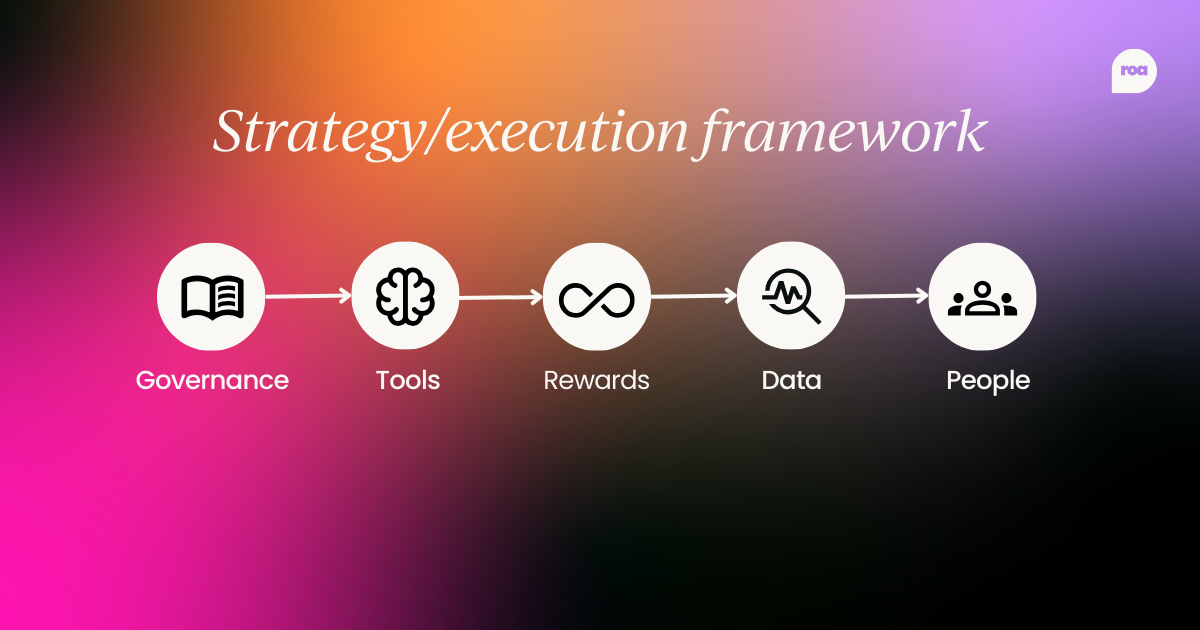
That's why I've organized my approach around five core dimensions:
- Governance
- Tools
- Rewards
- Data
- People
For each dimension, I'll share three specific tactics you can actually implement.
1) Governance: Creating structure without bureaucracy
When most people hear "governance," they think of endless meetings and approval processes. Red tape that slows everything down. Done right, though, governance actually accelerates execution.
Planning as an accelerator
Think of planning like a Formula 1 pit stop. You slow down initially, but only so you can go faster later. Invest time upfront in planning and you can forget about needless bureaucracy because you've built clarity.
What does this look like in practice? It means having clear approaches for resource allocation, budget distribution, and decision-making authority. More importantly, it means defining how these elements can flex during the year. (Because let's face it, no plan survives contact with reality.)
OKRs that actually drive accountability
Google might have popularized OKRs (objectives and key results), but chances are your organization uses some version of them. Whether you call them annual objectives, strategic priorities, or something else entirely.
Here's what makes OKRs powerful for execution: they create a clear line from vision to action. Take a software company targeting SMB growth. Your objective might be growing SMB revenue by 15%. The key result? Sign 20 new deals by Q1. Each deal has specific revenue targets that roll up to the larger goal.
This clarity creates consistency across teams. It makes accountability possible and, perhaps most importantly, it gives everyone a North Star by which to navigate when making daily decisions.
The accountability matrix challenge
We'd recommend using the RACI framework: Responsible, Accountable, Consulted, Informed. You might use RAPID or another model. The framework matters less than the clarity it creates.
Here's where things get tricky in matrix organizations: you often end up with multiple people accountable for the same outcome. Picture a shared P&L between market and product teams. Two decision-makers. Two perspectives. Potential for conflict.
Here's my take: The solution is to build collaboration into the accountability structure itself. Not to choose one team over the other. Define not just who's accountable, but how they'll work together when interests diverge. (Because, count on it, they will diverge.)
2) Tools: Beyond software to strategic enablers
When I say "tools," your mind probably jumps to software platforms. And yes, those matter. But tools encompass so much more: systems, processes, and even the narratives we use to drive alignment.
The power of narrative as a tool
This might seem counterintuitive, but narrative is one of your most powerful execution tools. Why? Because it answers the fundamental questions that drive human behavior: Why are we doing this? What's in it for our customers? What's the bigger picture?
Without a compelling narrative, execution becomes a compliance exercise. Your teams go through the motions without understanding the purpose. They can't make good decisions independently because they don't understand the context.
A strong narrative creates that North Star. It helps teams navigate ambiguity. It provides the "why" that sustains effort through challenges.
CRM as an execution enabler (not a reporting burden)
Here's a radical thought: your CRM should help sales teams sell, not just help management track metrics. (I know, revolutionary concept!)
The best CRM implementations provide clarity on where each opportunity stands in the sales cycle. They surface which decisions need to be made to move deals forward. They track progress against OKRs in real-time.
But here's the catch: this only works if the system is designed with salespeople in mind, not just management. Too often, we build these tools in isolation, then wonder why adoption is poor. Get your sales teams involved in the design process. Build something they'll actually want to use.
AI as a tool (with humans still in charge)
AI could easily fit under data, but I see it fundamentally as a tool. And like any tool, its effectiveness depends entirely on how we use it.
The key questions remain human ones:
- How do we instruct AI systems effectively?
- What prompts generate useful outputs?
- How do we interpret and apply the results?
- It's still garbage in, garbage out – just at a much faster pace.
For predictive analytics or automated workflows to drive execution, we need to design them cleverly. That means understanding both what AI can do and what it shouldn't do. The goal is to augment human judgment, not to replace it.
3) Rewards: Aligning incentives with desired behaviors
Everyone in your organization either receives rewards or manages them. Yet we often treat rewards as an afterthought, something HR handles. That's a missed opportunity.
Beyond the carrot and stick
Financial incentives are straightforward. Sales commissions. Performance bonuses. You hit the number, you get the reward. Simple, right?
Here's the problem: people adapt (in ways we might not always want them to). They find workarounds. And you can't run a marathon at sprint pace. Over time, financial incentives lose their power to motivate. They become expected rather than earned.
The real power lies in non-financial incentives:
- Career development opportunities.
- Public recognition.
- Growth assignments.
These tap into intrinsic motivation; the desire to master skills, gain autonomy, and contribute to something meaningful.
Recognition that reinforces the right behaviors
Recognition might seem like a "soft" tool, but it's incredibly powerful for driving execution. The key is being intentional about what you recognize.
Let me share an example. Imagine you're launching a new product. There are teething issues. A delay seems inevitable. But one employee escalates the problems early. Because of her proactive communication, management can intervene. What could have been a six-month delay instead lasts just three weeks.
On paper, she missed her KPI. The launch wasn't on time. But the behavior (early escalation, proactive problem-solving, courage to communicate bad news), that's exactly what you want to reinforce. Recognize it publicly. Make it clear this is the kind of execution excellence you value.
Building behaviors that drive results
What behaviors actually drive execution? In my experience, it's things like maintaining a growth mindset, being proactive rather than reactive, focusing on collaboration over silos, prioritizing outcomes over process adherence, and keeping clients at the center of decisions.
Easy to say. Much harder to do. But you can systematically reinforce these behaviors. There's something called "uplift", a peer recognition system tied to our leadership principles. Each month, employees can recognize colleagues who exemplify principles like "Execute with Excellence" or "Obsess about Customers."
The people with the most uplifts get recognized in town halls. It factors into performance reviews. It creates social proof for the behaviors that matter. Simple system, powerful results.
4) Data: From complexity to clarity
Data underpins everything I've discussed so far. But too often, we make it more complex than it needs to be.
Reporting that drives action
How many KPIs does your dashboard track? If it's more than you can remember, it's too many. The best reports are ruthlessly simple: RAG status (red, amber, green), clear ownership, defined timelines, and specific metrics. Four or five columns. That's it.
I have a tendency to create complex reports. Maybe you do too. But complexity doesn't equal sophistication. The goal is driving action, not impressing people with our Excel skills.
Focus on making reports:
- Action-oriented
- Automated (where possible)
- Leveraging real-time data
KPIs that differentiate
People often confuse KPIs with OKRs. Think of KPIs as the level-two and level-three metrics that ladder up to your key results. They're more granular and more specific.
But here's where strategy meets execution: your KPIs should drive the behaviors you want. If you're targeting 15% revenue growth, that's great. But maybe recurring revenue matters more than new sales for long-term health. Your KPIs should reflect that priority.
Same principle applies to market segments. Want to grow in hospitality rather than financial services? Build KPIs that track hospitality-specific metrics. Use your measurement system to focus attention where it matters most.
Data-driven decisions (with context)
Using data to drive decisions seems obvious. But here's what I've learned: people need to understand why decisions are made. They need context. They need to be brought along on the journey.
When decisions feel random or disconnected from strategy, execution suffers. People lose faith in leadership. They start second-guessing rather than acting.
So yes, make fast decisions when needed. But for significant choices, take time to explain the rationale. Share the data. Show how it connects to strategy. It might feel like slowing down, but it actually speeds up execution by building buy-in.
5) People: The heart of execution
I saved people for last intentionally. Despite all our automation, AI, and sophisticated tools, execution still happens through human beings. It's us that remains the most critical factor.
Breaking down silos (not just overcoming them)
Notice I said "breaking down" not "overcoming" silos. Sometimes you need to be forceful. Silos don't dissolve naturally, they're reinforced by incentive structures, reporting lines, and years of habit.
Real cross-functional collaboration requires changing these underlying structures. Nobody accomplishes anything significant alone in a large organization anymore. Yet our systems often reward individual achievement over collective success.
Recognize and reward cross-functional initiatives. Make collaboration a promoted behavior, not just a nice-to-have. And yes, sometimes you need to force the issue by restructuring teams or changing reporting relationships.
Client-centricity as a driving force
Here's a trap we all fall into: we build tools, reports, and processes for internal stakeholders. It's tempting. They're the ones asking for the reports, after all.
But execution excellence means working backward from client needs and pain points. Every system, every process, every decision should ultimately serve the customer. This should drive how you structure incentives, design your CRM, create reports, make funding decisions, and deploy talent.
Easy to say. Hard to do. Internal pressures are real and immediate. Customer needs can feel abstract and distant. But organizations that maintain this outside-in perspective consistently outexecute their internally-focused peers.
Culture as the connecting tissue
Culture is the glue that holds everything together. With the right culture, people lean in. They contribute ideas proactively. They're comfortable with intelligent failure, like the product launch delay I mentioned earlier.
But culture isn't about ping-pong tables and free snacks. It's about creating an environment where people can do their best work. Where they understand how their efforts connect to larger goals. Where they feel safe to escalate problems early rather than hiding them.
You can't mandate culture. But you can shape it through the behaviors you recognize, the stories you tell, and the decisions you make. Every action sends a signal about what really matters.

Making it real in your organization
21 words across five dimensions: governance, tools, rewards, data, and people. Are there overlaps? Absolutely. Could planning fit under data? Sure. Might decisions belong in governance? Of course.
The point isn't creating perfect categories. It's having a framework to think systematically about execution. Because here's what I know after years of working on strategy and operations: execution isn't about finding the one perfect approach. It's about addressing multiple dimensions simultaneously.
Some of these ideas will resonate with you. Others might not fit your context. That's exactly as it should be. There's no universal formula for bridging the strategy-execution gap. If there were, we wouldn't still be talking about it.
What matters is being intentional. Pick the elements that address your biggest gaps. Start small. Test and learn. Build momentum. Because ultimately, execution excellence isn't a destination, it's a capability you build over time.
The organizations that win aren't necessarily the ones with the best strategies. They're the ones that can consistently turn strategic intent into operational reality. They're the ones that bridge the gap between thinking and doing.
That's the real challenge we face in revenue operations. And it's why this work matters so much. Because without execution, even the most brilliant strategy is just a PowerPoint deck gathering dust.
What dimension will you tackle first?


Revenue operations alliance insider
Thank you for subscribing
Level up your revenue operations alliance career & network with revenue operations alliance experts.
An email has been successfully sent to confirm your subscription.
 Follow us on LinkedIn