
 8 min read
Let me ask you something...
How many hours did you spend last week on pricing approvals? Or untangling discount requests? Or explaining to sales why their "special deal" breaks every rule in the book?
If you're like most RevOps professionals, the answer is probably "too many."
I've been there. In fact, when I asked a room full of RevOps leaders this same question recently, nearly everyone raised their hand. We're all drowning in the operational minutiae of pricing. But we should be driving strategic decisions that actually move the revenue needle.
Here's the thing: pricing doesn't have to be the operational nightmare that keeps you from doing real strategic work.
Over the past few years, I've transformed pricing from a constant firefight into one of our most powerful growth levers.
Here's exactly how I did it...
The pricing disconnect that's killing your productivity
Picture this: Product is heads-down on their roadmap. Finance is obsessing over top-line numbers. Marketing's crafting the perfect positioning. And Sales? Well, they're asking for another discount.
Sound familiar?
Meanwhile, you're stuck in the middle trying to make sense of it all. You're the one who has to somehow turn these competing priorities into a coherent pricing strategy that actually works in the real world. You're the translator, the mediator, the enforcer, and somehow also the strategist.
This disconnect creates massive inefficiencies. Teams work in silos. Nobody talks to each other. And pricing becomes this reactive, ad-hoc mess instead of the strategic lever it should be.
I've seen this pattern play out in organization after organization. The result? RevOps teams spend 80% of their time on pricing operations and maybe 20% on actual strategy. If we're lucky.
But here's what I've learned: when you flip that ratio, magic happens.
Why pricing belongs in RevOps (and why now is the time)
You might be wondering why I'm so passionate about RevOps owning pricing. After all, couldn't product handle it? Or finance? Or... literally anyone else?
Here's my take: RevOps sits at the perfect intersection. You understand the customer journey. You see the data. You know what's actually happening in deals. And most importantly, you're the only team that regularly talks to everyone else.
I've developed a maturity model for RevOps, and here's what I've noticed. In Europe, we're mostly at level two – still building foundations, breaking down data silos, trying to get teams to work together. But in the US? They're having much more strategic conversations. They're at the point where product, pricing, and revenue strategy all work together seamlessly.
The difference isn't resources or talent. It's mindset. It's understanding that pricing isn't just about approvals and guardrails. It's about accelerating growth.
Let me share some numbers that might change your perspective:
- 67% of top-performing organizations have mature pricing capabilities.
- Companies with strong pricing governance grow significantly faster than their competitors.
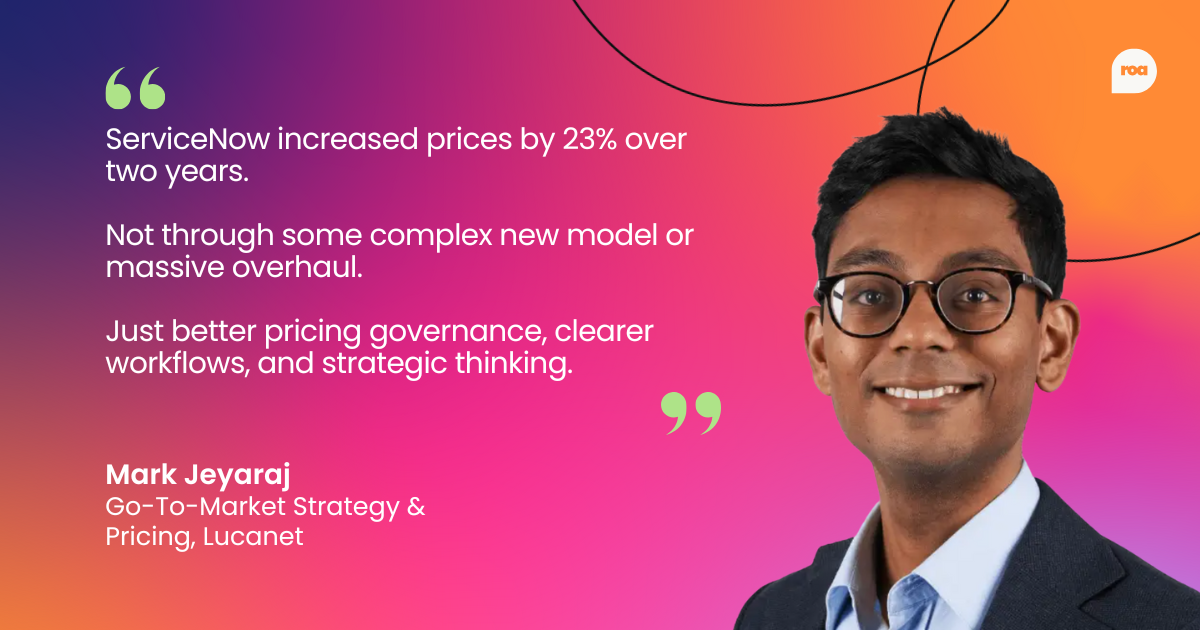
- ServiceNow increased prices by 23% over two years just by implementing better pricing governance.
That last one really gets me. A twenty-three percent price increase... Not through some complex new model or massive overhaul. Just better governance, clearer workflows, and strategic thinking.
The sweet spot for pricing in RevOps
Now, I'll be honest with you. Pricing in RevOps isn't for everyone.
Small organizations with a single product? Product management probably makes more sense as the owner. Large enterprises with complex, bespoke deals? You might need a dedicated pricing team.
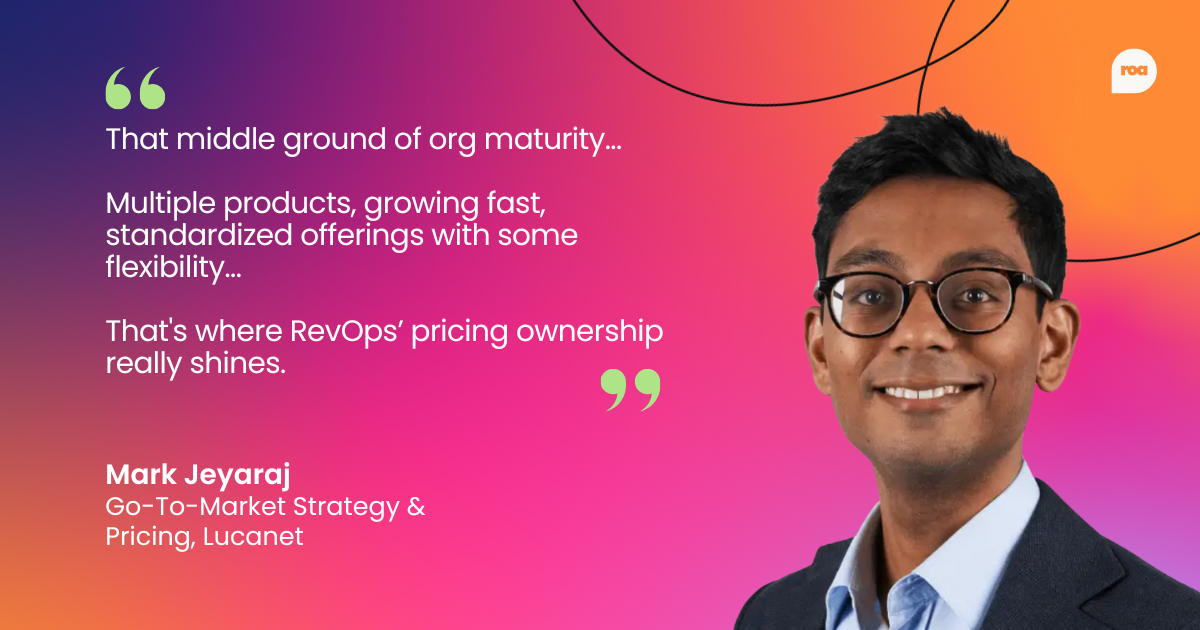
But for that middle ground – multiple products, growing fast, standardized offerings with some flexibility – that's where RevOps can really shine. That's what I call the "middle ground magic."
In this sweet spot, you can coordinate across teams while still being strategic. You can standardize processes without losing flexibility. You can drive real revenue impact without getting lost in endless customization.
Building your pricing foundation: Three pillars that actually work
Alright, let's get practical. Here are the three pillars I've used to transform pricing from an operational burden into a strategic asset...
Pillar 1: Governance that doesn't suck
Most pricing governance is either non-existent or so bureaucratic it kills deals. You need something in between.
First, create a clear RACI matrix. I work primarily with three teams: product, product marketing, and finance. Here's how we divide responsibilities:
- I own pricing strategy.
- Product owns packaging decisions (which features go in which tier).
- Product marketing owns positioning and value communication.
- Finance validates the models and ensures profitability.
Notice who's not on that list? Sales. I validate with them separately. They're crucial stakeholders, but they don't own any part of the pricing process. (Trust me on this one.)

Second, establish a pricing committee that actually adds value. We meet quarterly, not weekly. Why? Because weekly meetings become operational. Quarterly meetings stay strategic.
Here's exactly how we structure our pricing committee:
- Objective: Focus on strategic pricing decisions, not day-to-day approvals
- Criteria: Only topics that impact revenue by more than X% or affect multiple segments
- Attendees: Keep it small – product, sales ops, finance, product marketing. That's it.
The key is that open discussion section. We don't just review decisions. We talk about what's changing in the market, what customers are saying, what competitors are doing. And yes, everyone always wants simpler pricing. Always.
Pillar 2: KPIs that drive action
You can't improve what you don't measure. But most companies measure the wrong things.
Sure, track your basics: ARR, new customers, average order value. But the real insights come from more sophisticated metrics:
- Customer acquisition cost (CAC) by segment
- Customer lifetime value (LTV) by cohort
- Price elasticity by product line
- Win rate at different price points
Two weeks ago, I sat down with our CEO and CRO to review CAC and LTV across our ten main markets. We'd been tracking these metrics for two years. You know what we found? Three markets were massively underperforming. CAC was climbing, LTV was dropping.
The insight? We'd removed country-specific pricing factors in the name of simplification. Turns out, Spain and Italy really do need different pricing than Germany. Who knew? (Spoiler: the data knew.)
Pillar 3: Analysis that informs strategy
There are four types of analysis I run regularly:
- Segmentation analysis: After any product's been in market for six months, I dig into who's actually buying. Which industries? What size companies? What use cases? Then I make pricing decisions based on reality, not assumptions.
- Win/loss analysis: Honestly, the tool matters less than the discipline. When we lose a deal, I want to know: What price did we quote? What discounts did we offer? How did that compare to the winner?
- Competitive analysis: This ties directly to win/loss. I'm not just tracking competitor prices. I'm understanding their pricing models, their packaging, their value props.
- Price elasticity testing: This is where it gets fun. We survey customers about new products: "Would you pay more, less, or the same as Product X?" Simple question, powerful insights.
You ask four questions about price perception, and the data tells you the optimal price point.
But you need at least 50 responses. With our typical 20 customer interviews, we stick to simpler methods.
Making pricing strategic, not operational
Here's where most RevOps teams get stuck. They implement all the right processes but still spend their time on approvals and firefighting. The secret? Position pricing as a growth lever, not a governance function.
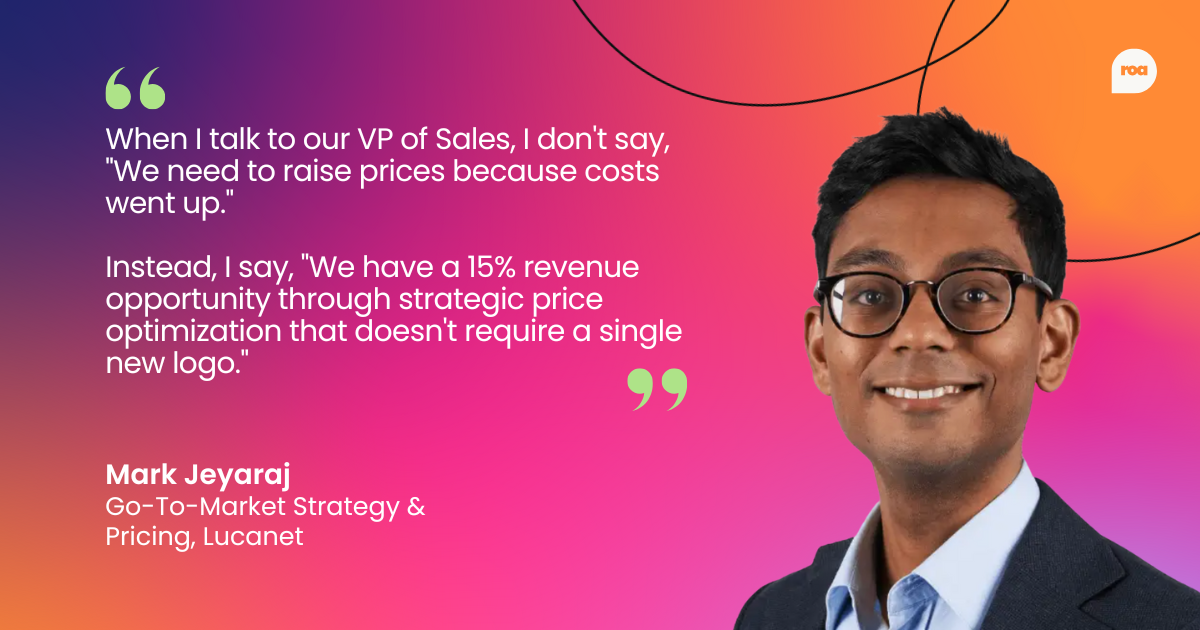
When I talk to our VP of Sales, I don't say, "We need to raise prices because costs went up." I say, "We have a 15% revenue opportunity through strategic price optimization that doesn't require a single new logo."
See the difference?
Pricing becomes a fourth growth lever alongside new customer acquisition, expansion, and retention. Sometimes it's the strongest lever you have, especially when other parts of the business are struggling.
Real-world implementation tips
Let me share what actually works in practice:
Keep your pricing committee small. I know everyone wants to be involved, but too many cooks really do spoil this particular broth. Sales will complain they're not included. They'll survive.
Data beats opinions, but not by much. Yes, use data to inform decisions. But remember, most pricing decisions are still hypotheses until they hit the market. That's okay. Make your best guess, launch it, then iterate.
Build in review cycles. I have an agreement with our CRO: every pricing change gets a three-month review. If it's not working, we adjust. This takes the pressure off getting it perfect the first time.
Simplify relentlessly. The best thing we ever did was move from seven different pricing models to a simple good-better-best structure. Our sales team could finally explain our pricing without a PhD in mathematics.
Unlock RevOps metrics mastery.
Take your revenue operations metrics game to the next level with our expert-led certification. And gain the necessary knowledge to measure your RevOps impact with confidence.
Handling the human side of pricing
Let's talk about the elephant in the room: sales gossip.
You know how it goes. One rep hears another got a sweet deal. Suddenly everyone wants the same discount. The partner team complains the direct team gets better pricing. Everyone's convinced everyone else has it better.
Here's how I handle it:
First, clear guardrails. Up to 15% discount needs no approval. Up to X% needs team lead approval. Beyond that, escalate up the chain. Simple, clear, documented.
Second, radical transparency. When someone comes to me with "I heard direct sales gets 30% automatic discounts," I pull the actual data. Nine times out of ten, it's a misunderstanding. The one time it's true? Maybe we need to adjust our strategy.
Third, I push operational approvals down the chain. If it's within guardrails, your manager can approve it. I'm not your pricing help desk. I'm here for strategy.
Resources for the pricing curious
If you want to go deeper, here are my go-to resources:
Blogs: Ibbaka's consulting blog drops great content weekly. The EPP pricing platform blog is solid for B2B SaaS. Pricing Society has good training if you want formal education.
Books: "Confessions of the Pricing Man" by Simon-Kucher's founder is my pricing bible. "Pricing with Confidence" is great for building conviction in your pricing decisions.
Podcasts: "Impact Pricing" is perfect for your commute. They focus on value pricing, which aligns perfectly with RevOps thinking.
Frameworks: The revenue model chapter in "Winning by Design" is essential reading. It'll help you speak the same language as your CRO.
The bottom line
Pricing doesn't have to be the operational burden that keeps you from strategic work. With the right governance, metrics, and mindset, it becomes one of your most powerful tools for driving growth.
Start small. Pick one area, build from there. Before you know it, you'll be the one raising your hand when someone asks who's driving strategic value through pricing.
Remember: you're not just managing pricing. You're unlocking revenue. There's a difference, and it's worth about 23% to your top line.
Now, who's ready to make pricing their competitive advantage?


Revenue operations alliance insider
Thank you for subscribing
Level up your revenue operations alliance career & network with revenue operations alliance experts.
An email has been successfully sent to confirm your subscription.
 Follow us on LinkedIn