 5 min read
Revenue Operations has become one of the most talked-about functions in modern go-to-market teams. Almost every scaling SaaS company claims to “have RevOps now”.
Job titles exist. RevOps tools are in place. Dashboards are everywhere.
And yet, many organizations still struggle with the same problems:
- Execution feels slower than it should
- Priorities keep shifting
- Teams feel overloaded
- Leaders aren’t confident in the numbers
- Strategy looks good on slides, but weak in reality
In my experience, this usually isn’t a tooling problem. It’s an ownership problem.
More specifically, it’s a lack of clarity around what RevOps actually owns, what it enables, and what it influences. When that line is blurry, execution suffers quietly and consistently.
This article isn’t about drawing rigid boxes or defending turf. It’s about why clarity of ownership is one of the biggest levers for execution and why RevOps sits right at the center of that.
The cost of unclear ownership
Most execution issues show up subtly.
Decisions take longer, meetings multiply, work gets started, but is not finished.
High effort but low visibility on results. Often, if you trace these symptoms far enough back, you land on the exact root cause: no one is truly accountable.
When ownership is shared, implied, or spread across committees, a few things tend to happen:
- Decisions get escalated unnecessarily.
- Trade-offs are avoided rather than made.
- New priorities sneak in without old ones being removed.
- Teams hesitate because authority isn’t apparent.
None of this is malicious. In fact, it often comes from good intentions. And this is where RevOps either becomes a force multiplier or a bottleneck.
RevOps is not a support function
One of the biggest misconceptions I see is treating RevOps as a service desk for the commercial organization.
Create this report, correct this field, set up this automation, and attend this meeting. Some of that work is necessary. But when RevOps is primarily positioned as a reactive support function, a few things happen quickly:
- Focus gets pulled in too many directions.
- Strategic work gets crowded out.
- The team becomes busy without being impactful.
- Execution slows rather than accelerates.
At its best, RevOps exists to help the business make better decisions faster. That means owning the systems, processes, and operating rhythm that underpin execution, not just responding to requests.
This requires a shift in how RevOps is expected to show up.
The three pillars of impact
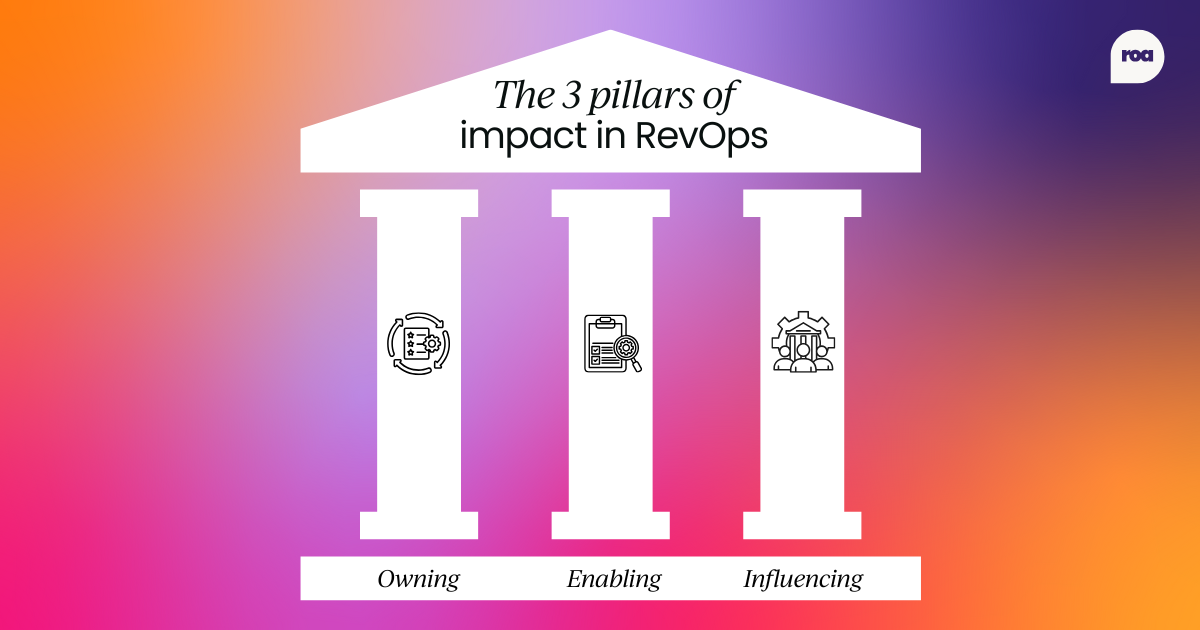
One of the simplest ways to create clarity is to separate responsibilities into three buckets: what RevOps owns, enables, and influences.
Not as a rigid framework, but as a way to force the right conversations.
What RevOps should own
RevOps ownership centers on total accountability for the structural health of the business, encompassing everything from data foundations and CRM architecture to forecasting mechanics and the overall go-to-market operating rhythm.
This is where RevOps earns trust. When these foundations are solid, leaders can focus on decisions rather than debating the numbers or the process.
What RevOps should enable
RevOps enablement focuses on empowering Sales, Marketing, and CS leaders through strategic insights, behavioral frameworks, and management tools that allow them to drive their own success rather than relying on others to do the work for them.
RevOps enables execution by making the right path the easiest one to follow.
What RevOps should influence
RevOps serves as a strategic navigator, using its visibility across the organization to influence better decision-making by flagging resource limits and guiding leadership away from 'everything is a priority' thinking.
This only works if RevOps is trusted and seen as neutral. Not sales-biased. Not marketing-biased. Not finance-biased and focused on outcomes.
 Simon Gilks
Why this clarity matters for execution
When ownership is clear, a few essential things start to happen.
- First, decision-making speeds up. People know who can make the call and who doesn’t need to be involved.
- Second, priorities become easier to protect. When new requests appear, they can be tested against agreed outcomes rather than added by default.
- Third, teams regain momentum. Work gets finished. Progress becomes visible. Motivation improves because effort leads somewhere.
This is especially important early in the year, when ambition is high, and the temptation to do everything at once is strong.
The leadership role RevOps plays
One of the most interesting themes that often comes up in conversations about execution is leadership protection.
Teams don’t lose focus because they’re undisciplined. They lose focus because priorities change faster than capacity.
RevOps can’t solve this alone, but it plays a critical role in surfacing the reality:
- What’s already in flight
- What trade-offs does new work introduce
- What impact does constant reprioritization have on delivery and morale
RevOps helps make that possible by providing visibility and cadence, not by adding more complexity.
Tools don’t fix execution problems
When execution wobbles, the reflex is to add something new: a tool, a dashboard, a process. Tools can help, but they rarely address the root cause. If ownership is unclear, tooling shifts the confusion elsewhere. If priorities continue to shift, dashboards better reflect the chaos.
Execution improves when:
- Ownership is explicit
- Decision rights are clear
- Focus is protected
- Cadence is consistent
Tools should support those things, not substitute for them.
RevOps ownership isn’t static
What works at 50 breaks at 500. As scale raises complexity and ambiguity, RevOps becomes essential, adding clarity without slowing teams down
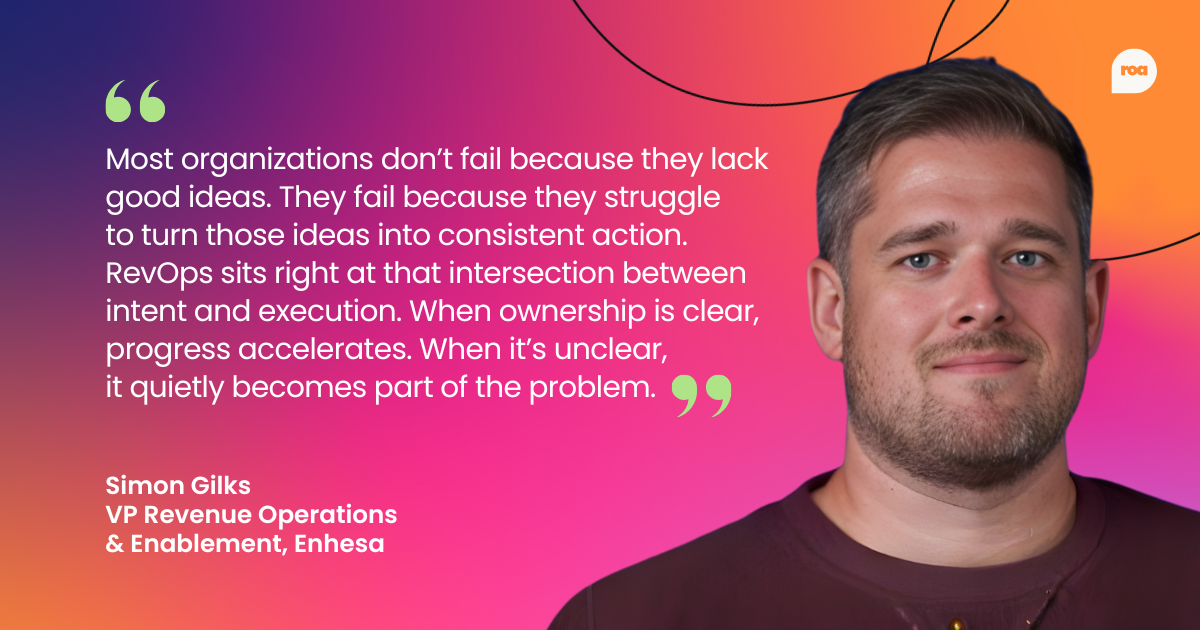
Most organizations don’t fail because they lack good ideas. They fail because they struggle to turn those ideas into consistent action. RevOps sits right at that intersection between intent and execution. When ownership is clear, progress accelerates. When it’s unclear, it quietly becomes part of the problem.
Execution thrives not on control but on clarity.


Revenue operations alliance insider
Thank you for subscribing
Level up your revenue operations alliance career & network with revenue operations alliance experts.
An email has been successfully sent to confirm your subscription.
 Follow us on LinkedIn