
 7 min read
When I joined GHD Digital two years ago, my challenge was to generate revenue for a SaaS startup inside a 100-year-old civil engineering consultancy. GHD’s legacy was impressive: a global leader in water, waste, transportation, architecture and urban development. Governments trusted us. Communities depended on us. But our new products and platforms division? We were a small, scrappy team trying to make a name in the government tech world.
Sales challenges
We had tremendous buy-in from the team, the support of our divisional CEO Ali Carden and an appetite for change, we also had several key challenges to overcome. The first was this: GHD Digital was poised to meet rising demand for digital solutions but was anchored in go-to-market motions that did not fit the dynamic realities of SaaS business models.
We lacked the specialized sales roles and commission plans: Everyone was an account manager; everybody wrote RFPs; everybody did everything. Business risk loomed large, processes were outdated, and our systems allowed for minimal knowledge sharing.
Most importantly, we lacked a consistent way of engaging prospects and customers. We didn’t know what “good” looked like, or how to scale it: Sellers defaulted to individual styles and lacked a consistent process for discovery, qualification and advancement. Successes were impactful but isolated.
Restructuring sales for scalable SaaS growth
I knew we were sitting on a huge opportunity, but we had to transform how we sold. We needed to blend GHD’s community values and deep expertise with the urgency and precision demanded by a digital-first economy.
Enter Tony Cascio, a Managing Partner at ValueSelling Associates, who helped us think about value-based selling not just as a sales methodology, but as a mindset.
- Step 1: Separate the roles. We developed positions for dedicated account executives (AEs), account managers (AMs), and an RFP team. This way there’s clear revenue streams and clear responsibilities.
- Step 2: Get everyone speaking the same language. To align GTM roles and ensure a consistent customer experience, we studied the ValueSelling Associates books chapter by chapter and met to discuss the application. With no initial budget for formal training, the books became a great equalizer, helping everyone, including senior leadership, speak the same language.
- Step 3: Put competitive commission plans in place. If we were going to attract top talent, we needed to pay top dollar.
- Step 4: Build a full SDR function to feed pipelines for AEs and AMs. Reps are encouraged to build their own pipelines and bring in their own leads, but we needed to fill their sales funnels.
- Step 5: Challenge the status quo. Stop waiting for RFPs and start proactively fostering multi-threaded relationships with our buyer personas to keep us top of mind.
Transitioning from command and control to trust and collaboration
The most powerful transformation at GHD Digital was in leadership philosophy. Sales training began with a leadership session across the entire business, including product management, marketing, sales leadership, and the divisional CEO, to ensure alignment on value-based principles and guidelines among anyone involved pre-, during, and post-sale.
Teaching executives to move from "command and control” to “trust and collaboration" created the foundation for sustainable change from the top down. With the divisional CEO Ali Carden and the executive team using the Value Selling Framework and terminology, everyone in sales followed suit and was aligned. This was especially helpful in deal reviews to hold reps accountable to the same standards.
Tony also spent time with the divisional CEO to develop a forward action plan that consisted of five leading indicators of the right behaviors and attitudes that would drive the performance-based culture. It became our religion.
If you wanted to know whether someone was performing well or not, it was straightforward: we simply checked their progress against those leading indicators. The process was consistent, focused, and left no ambiguity about expectations or accountability.
Now when we meet with Ali the only thing we look at is the metrics. Where are we green, where are we red, where do we need to adjust to get sales reps back on track.
Shifting from features to business outcomes
I like to reminds reps of this golden rule that aligns with value selling: money follows problems.
If we’re solving a real business issue for a buyer, the budget follows. If we’re just promoting product features, we’re in a price bake-off.
Our sales team used to sell based on product features and functions, and these deals were not forecastable. Reps would say the prospective buyer loved our product because it was “easier to use.” If you hear your teams saying something similar, I encourage you to push back and ask “What business issue are you solving?” Easier to use is not a problem that we are solving.
I don’t know any government organization that will spend taxpayer funded money for something that’s easier to use, especially if that means ripping and replacing a CMS.
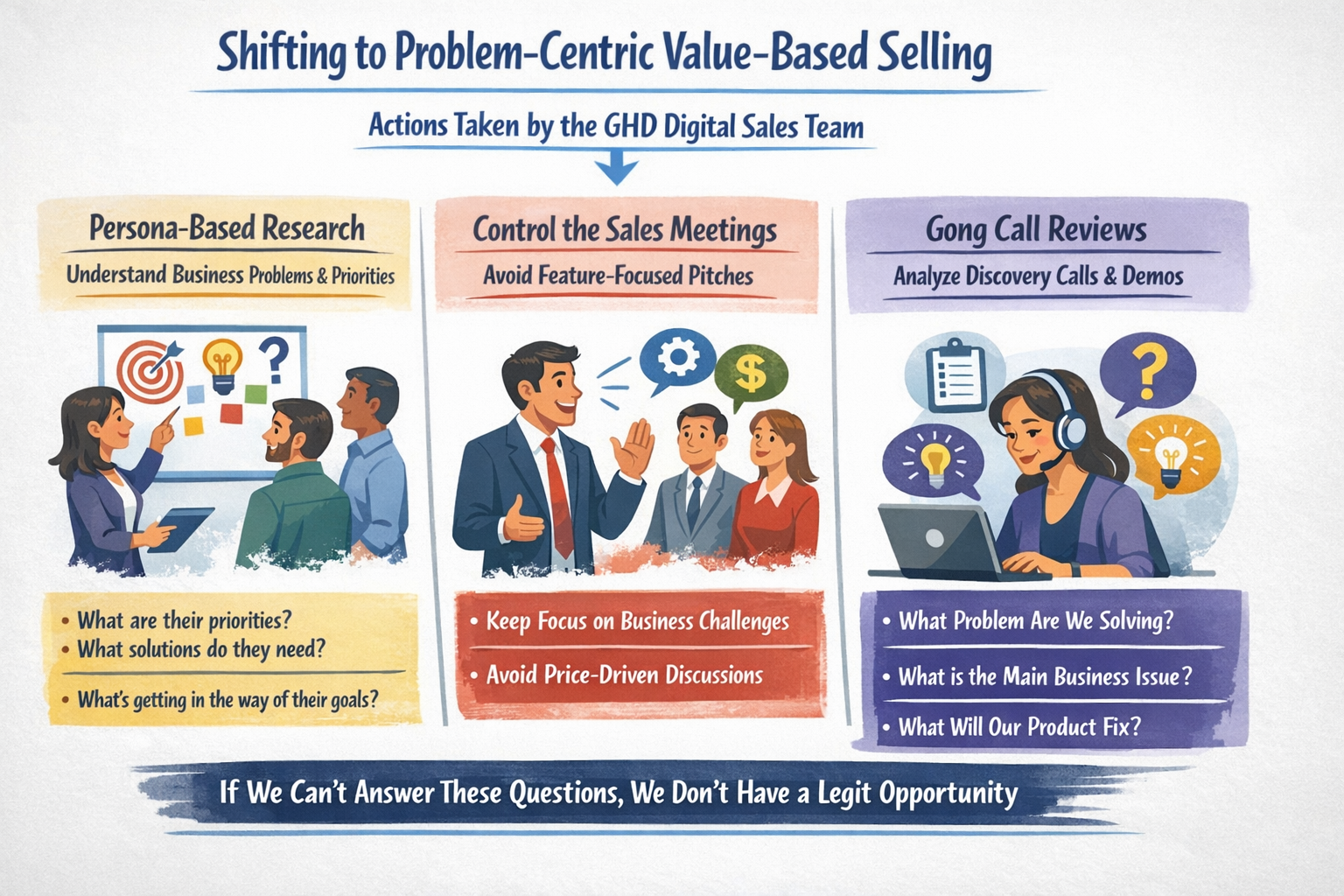
To move away from promoting product features and shift toward problem-centric value-based selling, the GHD Digital sales team took these actions:
- Conducted persona-based research to understand the business problems of our target audiences. What are their priorities? What solutions are they desperate to find? What’s getting in the way of their business goals?
- Took control of meetings and did not allow prospective buyers to lead them down the road of features and functionality. This leads to buyers comparing our products to competitors, and it becomes a price discussion.
- Conducted Gong call reviews of reps’ discovery calls and demos. I listen for answers to these questions: What problem are we solving? What is the main business issue? What is our product going to solve? If we can’t answer these questions, then we don’t have a legit opportunity in play.
Keep the sales process simple
Sales doesn’t have to be complicated. I learned early on that if you over-engineer your process, you lose the magic that makes great reps great. We want reps to be authentic.
To drive behavioral change from day one and maximize training return on investment, we built the ValueSelling principles right into our CRM using a revenue tech tool called eValuePrompter.
When a BDR books a meeting, that info flows through the entire sales cycle. It keeps everyone aligned and accountable.
During deal reviews, it’s pretty straightforward. If I open a deal and the eValuePrompter indicators are blank, that deal isn’t getting forecasted. When the critical elements are confirmed, the information is concise, and I can clearly see the business issue we’re solving that’s a deal we can stand behind.
Forecasting accuracy depends on preparation
Forecasting accurately, quarter after quarter, when everyone is aligned and prepared. Value-based selling is the back bone for how we oversee our pipelines and report to the executive teams. I tell our team all the time to be prepared for our monthly forecasting deal review meetings with the CEO. Trust me, you don’t want to be that rep who shows up to meeting unprepared. We’ve stopped meetings midstream before, and that’s a lesson no one forgets.
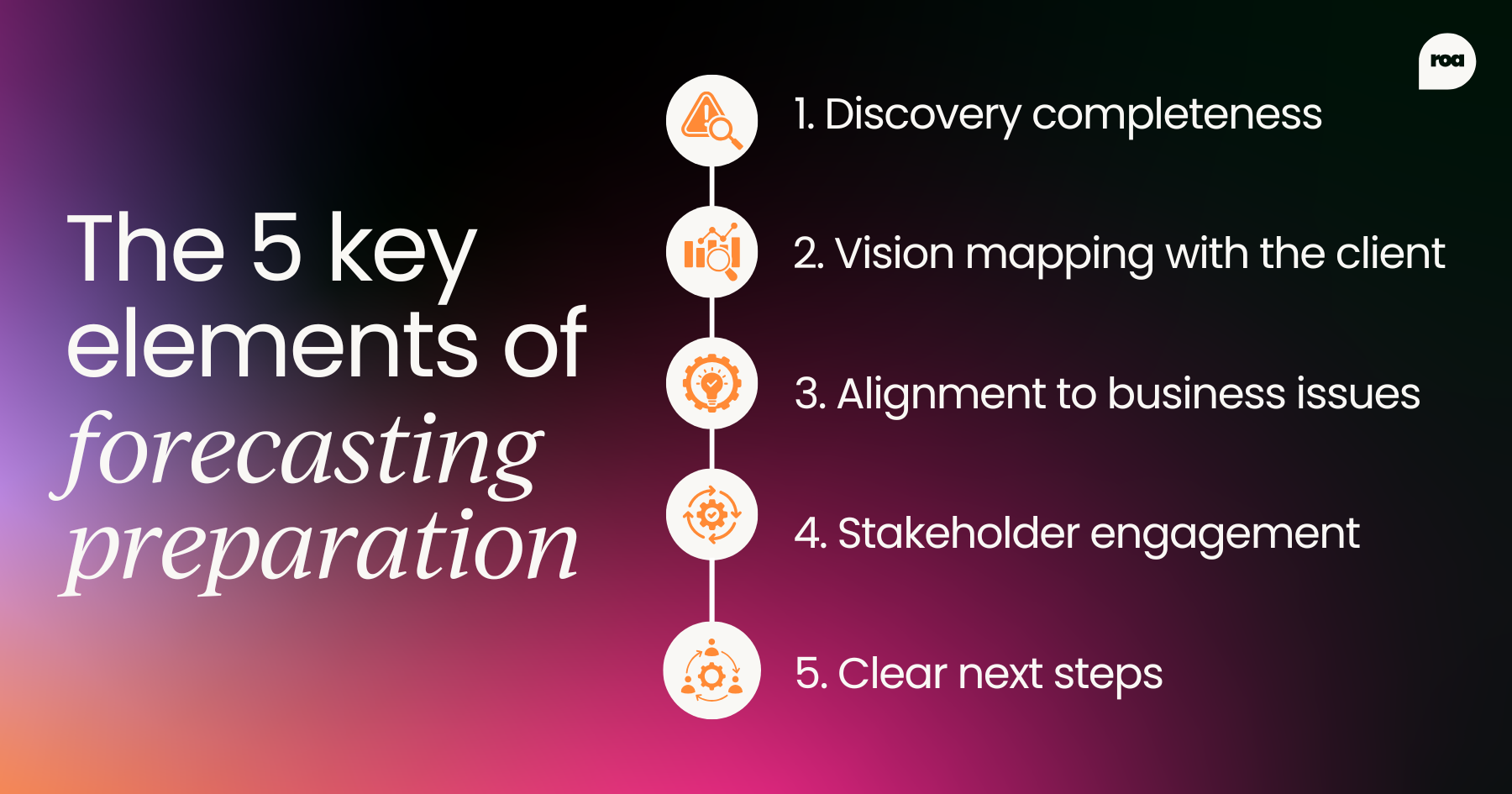
Our review process checks for five key elements:
- Discovery completeness
- Vision mapping with the client
- Alignment to business issues
- Stakeholder engagement
- Clear next steps
Two years later, we had a real sales organization. Quotas? Crushed. Pipeline? Solid. Forecasting? Accurate to the dollar.
The results speaks for themselves: six straight quarters of hitting quota and forecasting to the dollar, giving our CEO complete confidence in our sales team ability to accurately forecast to her executive team in Australia. Reps understand expectations, and we avoid wasted cycles. And we did it while staying true to GHD’s community values.
The transformation at GHD Digital delivered measurable, lasting impact:
- 450% increase in annual recurring revenue over 2 years, fueled by a structured sales motion and a proactive engagement strategy
- 140% improvement in year-over-year growth from 2023 to 2025, reflecting the team’s ability to land, expand and retain public sector clients at scale
- 160% pipeline growth year-over-year, while the division’s close rate climbed to 32%, marking a major improvement in both efficiency and forecast reliability
- 125% increase in average deal size
How to build your own sales forecasting machine
If you’re serious about driving steward leadership, the principles behind ValueSelling are universal whether you’re in hardware, software, SaaS, or product-led growth.
The framework cuts across industries because it’s grounded in something every great sales organization needs: clarity, consistency, and customer focus. When you pair those principles with relentless preparation and real buy-in from senior leadership, magic happens.
Doubling down on coaching, mentorship, and workshops hardwired that value-based selling mindset. Get your revenue organization to articulate what business issues they’re solving for their customers’ organizations, and you too can build a forecasting machine.


Revenue operations alliance insider
Thank you for subscribing
Level up your revenue operations alliance career & network with revenue operations alliance experts.
An email has been successfully sent to confirm your subscription.
 Follow us on LinkedIn