
 6 min read
AI was supposed to fix everything with faster pipelines, smarter forecasts, and less time on grunt work. It was supposed to mean more time on the stuff that actually moves deals forward.
So, why are so many revenue teams still stuck in the same bottlenecks?
We spoke to 35 CROs from around the world to find out.
Here's what they told us.
First, the bottlenecks nobody wants to admit to
Before we talk about AI, we need to talk about the pipes it's being asked to run through.
When we asked CROs to name the single biggest bottleneck in their revenue cycle, three answers kept coming up:
2. Forecasting accuracy, cited by 1 in 5.
3. Quote-to-cash speed, cited by nearly 1 in 6.
None of these are new problems, but they're getting more expensive to ignore.
Take quote-to-cash, for example. We asked CROs exactly how long it takes their teams to turn a quote into cash. The answers were all over the place, from a single hour at one end to 24 months at the other.
Even ignoring the extremes, the range ran from 4 hours to 110 days.
Slower quote-to-cash cycles suggest a process problem: the issues in question can range from manual data entry, pricing locked in spreadsheets, or approval chains that move at the pace of internal email. The teams operating at the 4-hour end have digitized the entire workflow.
And the cost of being on the wrong end of that gap compounds fast. Longer sales cycles bloat your CAC Payback Period. Reps quoting the wrong SKUs (for example) miss the expansion opportunities that are now, more than ever, where growth actually comes from.
That last point matters more than it might seem.

Where is new revenue actually coming from in 2026?
Here's a number that should change how you think about your GTM motion.
Revenue growth at public software companies has dropped from 57% in 2023 to 27% in 2025.
New logo acquisition is harder, slower, and more expensive. Which means expansion, growing revenue from customers you already have, is becoming the primary growth lever for most organizations.
That's exactly why Net Revenue Retention (NRR) has emerged as the north-star metric for CROs in 2026.
More than a quarter of our respondents named it as their primary revenue efficiency metric. It captures everything: churn, upsell, cross-sell, and price increases, all in a single number that tells you whether your revenue engine is actually working.
But here's the problem: if your quote-to-cash process is slow, your pricing is inflexible, and your reps are working from fragmented systems, you can't capitalize on expansion. Even when the opportunity is right in front of you.
If the operational infrastructure isn't there, no amount of AI investment will fix it.
The pricing problem hiding in plain sight
Underneath the quote-to-cash issue is a related frustration that CROs are increasingly vocal about.
Nearly 1 in 5 told us their single biggest pricing-related frustration is an inability to model new pricing structures quickly. In a high-tariff, volatile-cost environment, that's a competitive liability.
If updating a quote to reflect new costs takes your team 30 days and a dozen spreadsheets, you lose the deal. It's that simple.
The leaders who've solved this have automated the end-to-end revenue lifecycle. They can model new pricing and move from approval to signature in hours. That's what protects your margins when the market shifts, and right now, the market is shifting constantly.
The RevOps function is supposed to own this. Closing the gap between where RevOps is and where it needs to be is exactly what this community was built around, and our data shows there's still significant ground to cover.
When we asked CROs to rate the maturity of their RevOps function on a scale of 1 to 5, the average score was 3.39. More than a third rated it a 3, meaning the infrastructure exists. It’s the discipline to build it fully that's still missing in most organizations.
There's still significant ground to cover.
So, where is AI actually working?
Here's the good news: AI is generating real, measurable results for revenue teams. Just not across the board, and not automatically.
The applications with the highest success rates right now are pretty specific.
Predictive lead scoring is the standout, cited by more than a third of CROs as their most successful AI application.
Instead of static Ideal Customer Profiles, teams are dynamically scoring leads using real-time signals: hiring patterns, funding rounds, tech stack changes, executive moves, and content engagement. The result is a pipeline that's better targeted from the start, with sharper forecasts to match.
Meeting prep and account research come in second. GenAI as a copilot for pre-call preparation, eliminating hours of manual research and letting reps walk into conversations better prepared. Nearly a quarter of our respondents are doing this with measurable results.
Conversation intelligence rounds out the top three. Digesting large volumes of call data to automatically update CRM records, surface themes, and coach reps on what was actually said, not what they think they said.
These work, but they're also relatively contained. The harder question is what happens when you try to scale.
Your process is the problem (not the AI pilot)
This is the finding that should make every CRO stop and think.
When we asked what's preventing AI initiatives from reaching measurable ROI, the top answer, by a significant margin, wasn't budget or technology or even data quality.
It was getting people to actually use it.
Nearly half of our respondents (48%) said the biggest challenge is embedding AI into human workflows. Pilots sit outside core GTM processes; they're interesting, but they're not essential. Nobody's day breaks if the AI tool goes down.
The shift that separates the leaders from everyone else is a process redesign. As one of our contributors put it:
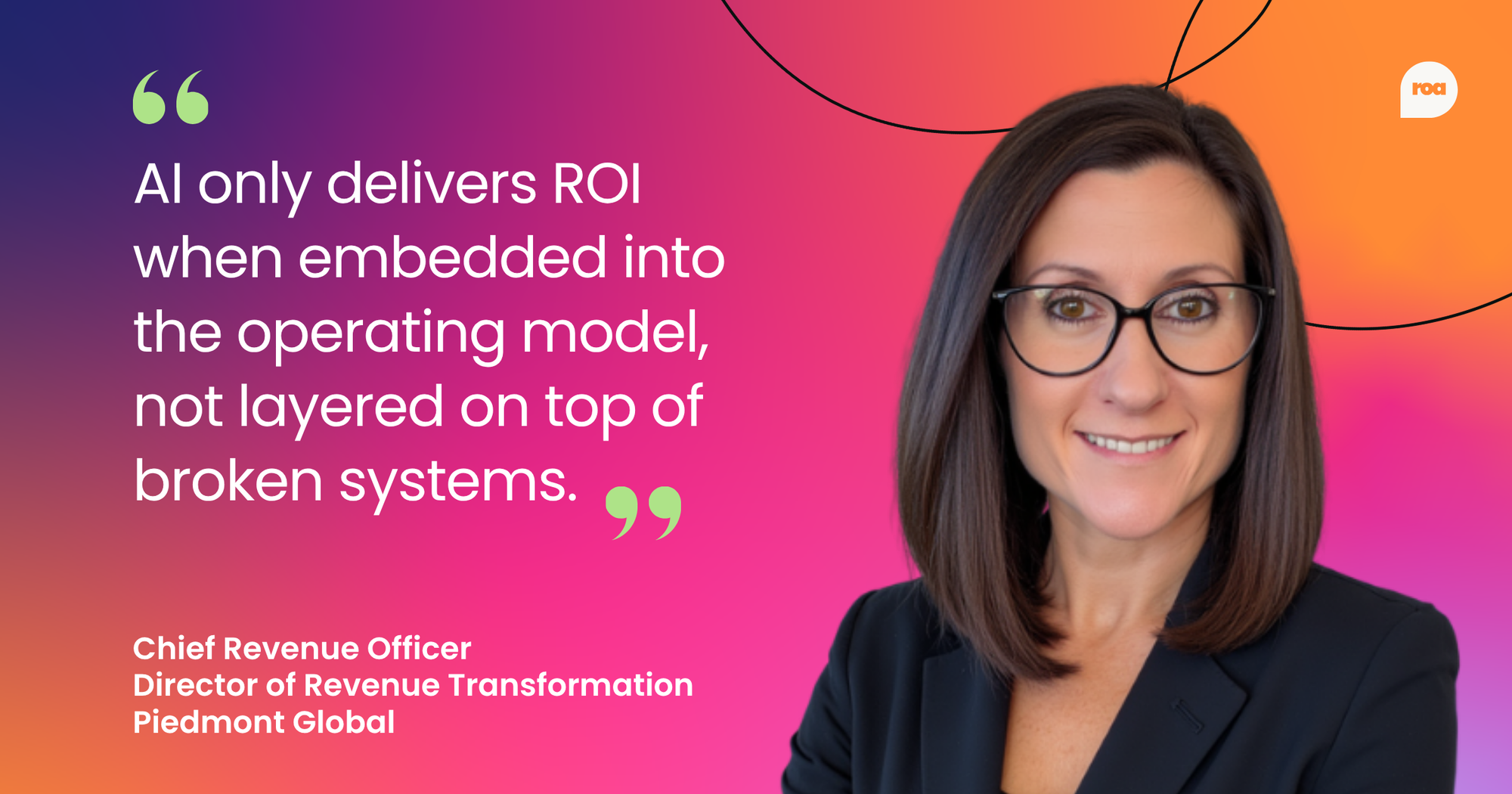
If your existing processes are inefficient, AI will just make them fail faster and at a greater scale.
The other three scaling challenges are worth naming, too:
1. Proving ROI trips up 35% of CROs. When you can't directly tie an AI deployment to a hard revenue metric, conversion rate, deal velocity, and NRR, it's almost impossible to justify scaling it. The teams that get past this define their success metrics before they start, not after.
2. Time and internal expertise are constraints for a third of respondents. Most organizations don't have the bandwidth to manage the transition from small pilot to enterprise-wide deployment, especially under the current pressure to focus every resource on what's already proven to work. It's a genuine catch-22.
3. Data quality rounds out the top four at 26%. AI needs clean data. Most GTM tech stacks don't have it. Pilots run on curated datasets and look promising. Production environments are messier, and that's where the results fall apart.
What the leaders are doing differently
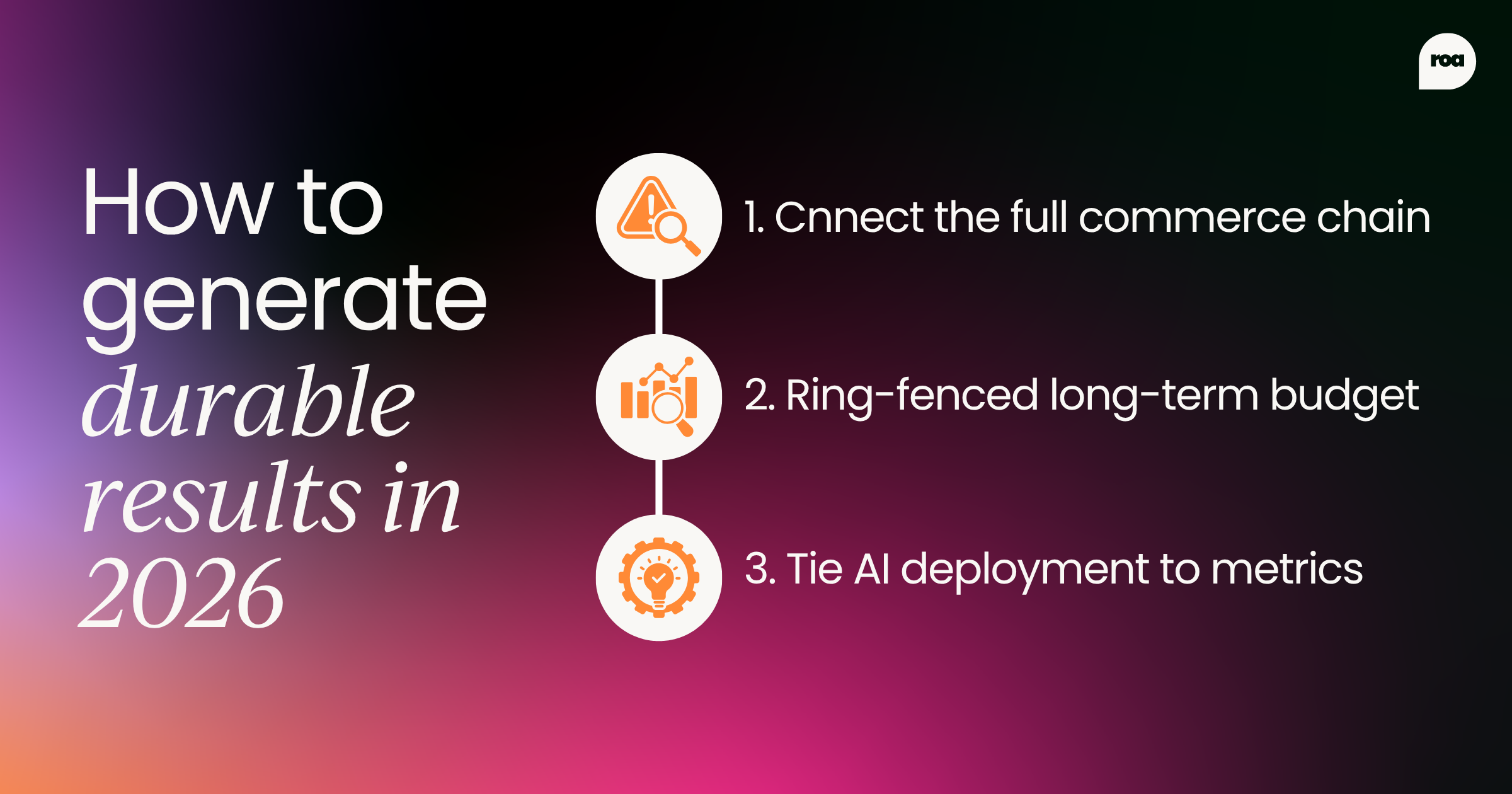
The CROs generating durable results in 2026 are the ones who've consistently done three things.
1. They've connected the full commerce chain
Not just aligning their GTM teams, which is necessary but not enough.
They've connected every function that touches the creation, capture, and realization of revenue: pricing, quoting, contracting, billing, finance, and legal.
When those processes run on shared data with shared visibility, deals move faster, and margins hold.
2. They've ring-fenced their long-term budget
The majority of our CROs allocate 20–30% of their GTM budget to long-term initiatives (median: 25%). What sets the leaders apart is how fiercely they protect that percentage.
Strategic funds get raided mid-quarter when short-term pressure mounts, but the best CROs prevent that by treating long-term investment as non-negotiable rather than discretionary.
That budget is for more than R&D. It's what fixes the quote-to-cash bottlenecks and what builds the data infrastructure needed to make AI actually work at scale.
3. They tie every AI deployment to hard efficiency metrics from day one
NRR, CAC Payback, win rates, and deal velocity – if a deployment can't move one of those numbers, it stays a pilot.
The bottom line
The technology needed to build a resilient revenue engine is now available to almost everyone.
That's the good news.
The bad news, or the opportunity, depending on how you look at it, is that the competitive advantage has shifted entirely to execution. To operational rigor. To the CROs who are willing to fix the underlying systems before layering AI on top of them.
The bottlenecks are real, but they're not inevitable.
The CRO Insights Report 2026 is free to download and goes much deeper than this.
Put together in partnership with Gong, Conga, and Backstory, it's built on real conversations with 35 revenue leaders from around the world, covering everything from AI governance and pricing bottlenecks to budgeting models and the metrics that actually matter this year.


Revenue operations alliance insider
Thank you for subscribing
Level up your revenue operations alliance career & network with revenue operations alliance experts.
An email has been successfully sent to confirm your subscription.
 Follow us on LinkedIn